Tobacco pipes, summer outdoor dining, tansu chests, chochin lanterns, juzu rosaries
The history of tobacco and bamboo pipes in Japan: Tobacco entered Japan in the Momoyama period (1568-1600) and was introduced by early Portuguese traders. The Portuguese were really the first European power to tap into the fabulous wealth moving out of Japan to China (the so-called gold ships) and also coming into Japan from China. Tobacco was smoked using a bamboo pipe with a fine metal fitting on either end.
Though cigarettes rapidly gained popularity at the turn of the 19th century, kiseru bamboo pipes are still used by some people. Kyoto and Tokyo were both important centers for the production of kiseru or bamboo tobacco pipes until WWII. Kiseru pipes made in Kyoto were prized as the best throughout Japan. Although they are no longer commonly used for smoking tobacco, they are still highly valued as curios or antiques.
Kiseru usually have three parts: a bowl and a mouthpiece made of gold, silver or brass, and a long stem made by from high quality bamboo. These bamboo stems were often dyed red, black or amber, some were painted by hand. The bamboo (prepared by boiling and drying) used for these pipes is called shinobe and comes from Hakone in Shizuoka Prefecture. Shinobe also absorbs nicotine well. Shinobe bamboo is now extinct in Shizuoka Prefecture due to massive golf course developments, etc. Now all remaining bamboo pipes are made from stock materials.
Kyoto only has one kiseru craftsman left. Mr. Tanigawa, the 9th generation master craftsman (Japanese handicrafts), makes as well as repairs kiseru pipes. Mr. Tanigawa’s shop sells a wide range of kiseru. Open: 10:00-18:00. Closed on Wednesdays. Located on Gokomachi, north of Takatsuji. Tel: (075) 351-5762.
The rest of this post covers:
- Summer Kyoto outdoor riverside dining experiences
- Kyoto's Okazaki district, flower roads & ancient spots
- The beauty and utility of Japan's tansu wooden chests
- Japanese paper chochin lanterns
- Juzu Buddhist rosaries, linked beads with meaning
Content by Ian Martin Ropke, owner of Your Japan Private Tours (est. 1990). I have been planning, designing, and making custom Japan private tours on all five Japanese islands since the early 1990s. I work closely with Japan private tour clients and have worked for all kinds of families, companies, and individuals since 1990. Clients find me mostly via organic search, and I advertise my custom Japan private tours & travel services on www.japan-guide.com, which has the best all-Japan English content & maps in Japan! If you are going to Japan and you understand the advantages of private travel, consider my services for your next trip. And thank you for reading my content. I, Ian Martin Ropke (unique on Google Search), am also a serious nonfiction and fiction writer, a startup founder (NexussPlus.com), and a spiritual wood sculptor. Learn more!
Summer Kyoto outdoor riverside dining experiences
June is traditionally the month when eating and drinking places along the banks of the Kamogawa River erect large wooden platforms, called yuka. This year, some places have decided to open a month early. If you’re in town, don’t miss this Japan al fresco experience.
Yuka extend out over the riverside and make for an unforgettable place to have dinner under the clear sky during warm and relaxing evenings. These open-air dining areas are unique to Kyoto and, though they have a reputation for being very expensive, you’ll be pleasantly surprised at how reasonable the prices can be. In addition to the beautiful views over the river and the eastern skyline, the excellent food, lively, open setting makes for good company.
Yuka first appeared in the late 16th century along the Kamogawa River in the area around Gojo which is about a kilometer or so south of where most of them are today. In those days these outdoor eateries were nothing more wooden benches placed along the side of and sometimes in the Kamogawa River. Here, people brought their own food and drink which they enjoyed while sitting near the water, with some of the lower classes probably going so far as to dip their bare feet in the river. Over time, as the popularity of yuka grew, the structures became more elaborate, eventually assuming their present-day form. Walk along the river and pick the place you’d like to spend a couple of hours eating and enjoying yourself at like an emperor, then head up onto the street and join the scene. Here’s just a little practical advice to make sure everything goes well.
A word regarding etiquette at yuka — anyone who objects to sharing a table with others should eat indoors; if a sudden storm blows up, guests are expected to grab their own dishes and come inside, otherwise it will be impossible to sort out whose food is whose afterwards. But let’s hope it won’t rain. Enjoy your meal and the natural delights of Kyoto by night!
This month, look for katsuo or bonito, a variety of tuna that is served raw. Another thing to look for are mountain vegetables or sansai, wild delicacies that grow in the mountains at this time of year. Common delicacies include warabi (bracken), zenmai (flowering fern), seri (Japanese watercress), yomogi (mugwort), and tara no me (for which there's no English equivalent). Although sansai can be prepared many ways, they are usually boiled and then flavored with mustard, sesame seed, vinegar, soy sauce, or sweet sake. They can also be cooked with rice, or made into a delicious tempura. From June onwards, the menu increasingly features ayu, a small kind of river trout that is as beautiful to look at as it is tasty, and very popular on yuka menus. Cold somen noodles are also recommended. Later in June and on through the summer hamo, or sea eel, and unagi, river eel, are common on the menu and frequently the favorite, as both are reputed to cool the body.
Kyoto's Okazaki district, flower roads & ancient spots
Heian Jingu Shrine is located in the spacious area known as Okazaki. Its entrance off Jingu-michi is marked by enormous red shrine gates, or torii. Most of the city's museums are in this area as well, along with the zoo, and a concert hall (Kyoto Kaikan). It is a place that is frequented by the city's citizens and visitors. Many older Kyoto residents fondly remember the canal that runs around the museums as the place they first learned to swim.
Ninety-eight years ago, the city of Kyoto celebrated the 1,100th anniversary of its founding. For the occasion, the city fathers decided to build a Shinto shrine in honor of Kammu, the emperor who founded the Heian capital of Kyoto. A committee of citizens decided that the shrine's architecture should be modeled on Chodo-in, a set of buildings that existed in the ancient capital. Mr. Kazuo Hondo, one of the shrine's administrators in the 1980s, explained the history of the site:
"When the Meiji Emperor moved to Tokyo, the city's population decreased by two-thirds and more land became available. Back then, this area consisted mostly of vegetable and rice fields, but when construction began, evidence was uncovered that six temples known as Rokusho-ji once stood here."
Records state that these temples covered a vast tract of land that stretched from the Shirakawa district to Sanjo Street. All buildings were almost entirely destroyed by the great earthquake of 1185, and never rebuilt. Then, in the Middle Ages, Bifuku Mon'in, the consort of Emperor Toba, was given this site as the place to build her palace.
Today, the shrine and its garden are visited by thousands daily, especially during spring, when the south garden is enveloped in the delicate pink blossoms of the hanging cherries, and May, when the azaleas take over, and then in June, when the color spectrum changes to purple as the irises that line great portions of the ponds in the west and central gardens bloom.
In keeping with the 1,000 year old architecture upon which the replica was based, the famous gardener, Ogawa Jihei (1860-1933), designed a stroll-through garden as was popular in the Heian period. One of Japan's great gardeners, his work received national recognition almost as soon as it was finished. Its maintenance keeps ten gardeners busy year-round and requires a great amount of money, some of which comes from the admission fees paid by thousands of yearly visitors.
Those only familiar with Western irises can look forward to meeting the aristocrats of this species. The first Japanese iris to make its appearance in Europe in 1872 was the roof iris (ichihatsu), so named because it was found growing here on the roofs of thatched farmhouses. The hanashobu iris is a symbol of young boys, and adorns the sets of armor displayed in homes in May to celebrate Children's Day. The rabbit-ear iris (kakitsubata) and blue-flag iris (ayame) stand 25" to 30" (60 to 80 cm) tall, and are slender-leafed with rather flat tops compared to the fuller, more rounded Western iris. The color range includes yellow ones and white ones and all shades of purple.
Although Ogawa employed some typical Heian period gardening conceits, the garden is modern in its use of space. Essentially a stroll garden, it is also for viewing. Most visitors enjoy their last look from the seats that line the covered bridge, a structure that was moved here from the Imperial Palace.
"The stepping stones in the central garden are actually old pillars from the Gojo and Sanjo Bridges built by the military ruler, Hideyoshi, about 400 years ago. Called the 'Bridge of the Lying Dragon', the stones form the tail while the small island forms the body. Many of the rocks are from Hideyoshi's castle in Fushimi," said Honda, who, in spite of daily contact with the garden, is still obviously in love with it.
There is one special patch of irises on the south side of the central garden, just opposite the stepping-stone dragon bridge. They are marked by a tall wooden sign that reads orizuru. Ori refers to origami or the art of paper folding, and zuru means crane. The irises resemble folded paper cranes, and are among the garden's prize blooms. "Because we worry about cross-pollination and want to make sure we preserve a pure strain," explained Honda, "several of these flowers are housed elsewhere."
"When the garden was first constructed, the trees that form the north border were kept short to allow a view of the mountains — a gardening conceit known as shakkei, or borrowed scenery. Nowadays, we've let the trees grow to block out all the high-rises that have gone up."
"Another recent development has been the proliferation of ma-shijimi. These tiny clams made their appearance in the garden's streams about eight years ago. This species of clam was once found throughout Lake Biwa to the northeast of the city, but disappeared as pollution in the lake increased. A few must have made the journey via the aqueducts that carry water into the city and settled down here. We are delighted to have them and think it is a good indication of the purity of the water." I asked how they tasted. "Of course, we never eat them," Honda-san replied. "This is sacred ground and no one is allowed to use any part of it for personal consumption." Gulp.
In June the irises are magnificent, rain or shine, and along with those at Ota Jinja in the north part of the city, should not be missed. Both spots are famous for iris-viewing and have a breathtaking number of flowers, a stunning tribute to the skill and artistry of Japanese horticulturists of yore.
Another flower that begins to bloom in June and continues all through the summer is the water lily. Heian Jingu's garden is one of the few which allow this aquatic beauty the space it needs. Whether the flowers are rain-soaked or sun-drenched, save a roll or two of film for this garden.
South of Heian Jingu, close to the Okazaki area is the imperial Tendai temple of Shoren-in Temple, also called the Awata-guchi Palace since it was once the residence of the Empress Go-Sakuramachi. The temple was built in the middle of the Muromachi period (1443-1489). The massive camphor trees that grip the moss-covered slope just outside its gate are a famous Kyoto landmark. The garden, like that of Heian Jingu, is an elegant stroll garden. Since it seems to be by-passed by most of the big tour groups, it is also one of Kyoto's better kept secrets.
In June, a small patch of blue-flag irises will be in bloom, but this temple offers much more. The grounds are well-tended, and visitors can wander along winding and hilly paths through shady woods and past a bamboo grove. Admission is ¥400. The entrance to the garden is through a distinctive low gate to the left. The path circumnavigates the entire temple area and brings you back to the main building. Besides offering excellent views of the garden, this structure also contains some magnificent painted cedar sliding doors.
In the far back is another garden, a flat, open space of white gravel partly shaded by another huge camphor tree. The stone wall that forms the south backdrop is part of Chion-in, a temple complex that extends all the way to Maruyama Park.
Chion-in is also an imperial temple, and its grounds contain twenty-one sub-temples. It is one of the headquarters of the Jodo sect of Buddhism. Regardless of whether or not services are being held, visitors are welcome to enter the great hall where beautiful Buddhist images give off a soft golden glimmer. The large tatami room before the altar is cool and dark, and heavy with the scent of the incense lit by worshipers. On the grounds is the largest bell in Japan. It weighs seventy-four tons and is inscribed with the date 1636. It is possibly one of the best-known bells in the country, being rung 108 times by resident monks on New Year's Eve, an event that is televised. The colossal sammon, or main gate, is also famous. Following restoration work on its second floor, it was opened in May for the first time in 370 years. Unfortunately, it is now closed to the public.
The rainy season begins in June, but this shouldn't be a cause for concern. Kyoto is the best place on the planet to be on a wet day. The rain is not chilly, but warm. Besides an invigorating freshness, it brings to all the gardens a kind of clarity and depth of color that is often washed out in intense sunlight. Just don't forget your umbrella!
Content by Ian Martin Ropke, owner of Your Japan Private Tours (est. 1990). I have been planning, designing, and making custom Japan private tours on all five Japanese islands since the early 1990s. I work closely with Japan private tour clients and have worked for all kinds of families, companies, and individuals since 1990. Clients find me mostly via organic search, and I advertise my custom Japan private tours & travel services on www.japan-guide.com, which has the best all-Japan English content & maps in Japan! If you are going to Japan and you understand the advantages of private travel, consider my services for your next trip. And thank you for reading my content. I, Ian Martin Ropke (unique on Google Search), am also a serious nonfiction and fiction writer, a startup founder (NexussPlus.com), and a spiritual wood sculptor. Learn more!
The beauty and utility of Japan's tansu wooden chests
Tansu wooden chests and cabinets have always been one of the most popular items for Japanese antique aficionados. They fit equally well into Japanese and Western style interiors, and make for excellent storage space. The origins of these beautifully crafted pieces of furniture lie in the Korean wooden chests (used to store clothing) which were popularly imported into Japan more than 300 years ago. Prior to introduction of the Korean-style chest, Japanese clothing was generally stored in rectangular, lacquered wooden boxes, lined with kiri (pawlonia) for moisture absorption.
The design and materials used in the earliest Japanese tansu were strongly regulated by the privileges of class. Feudal lords (daimyo) and warriors (samurai) were permitted to use precious woods (such as keyaki or zelkova) as well as being able to incorporate their family crests into the frontal design scheme. In the imperial and wealthy warrior residences, tansu were not used to decorate living space, but were instead hidden away in special tansu storage chambers. Clothing was transported from the tansu chamber to the members of the household on large wooden trays by servants.
Distinctly Japanese tansu designs began to appear around the middle of the 18th century in response to the growing stature and wealth of the merchant class. Special bridal chests, which formed part of the marriage trousseau, also developed around this time. Known as yome-iri-dansu, these chests consisted of either two or three stacked sections, depending on the wealth and status of the families involved in the marriage agreements. The more-prized and more elaborate three-section chests were used in the following manner: the top for kimono accessories, etc., the middle for kimonos, and the bottom for underclothing. For the antique collector or interested tourist sizes, types of wood, and styles of drawers and finishes in tansu, depending on the region in which they were made and their original function.
Japanese paper chochin lanterns
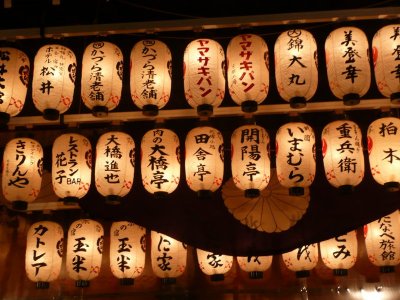
The Japanese chochin lantern was an essential part of everyday Japanese life throughout Japan until the beginning of the 20th century, when electricity came into widespread, sudden use.
In the beginning chochin were made simply by covering a mesh of interwoven thin bamboo slivers with rice paper. The folding or collapsing style, which is in common use today, dates from the early Edo period (1603-1868). These highly portable lanterns were revolutionary in major urban areas because they enabled the common people to freely walk around at night.
Commonly used chochin styles
1. Rossoku: Used for wedding ceremonies (late Edo). 2. Sokugen Chochin: Used on kago palanquins (mid Edo). 3. Bajo Chochin: Used as signal lights for horse traffic (Edo). 4. Kaichochin: Used for night time travel (mid Edo). 5. Komatsuri: Used for ceremonial occasions in Osaka merchant families (Early Edo to early Showa).
In Kyoto, with its long historical background as the capital, people were accustomed to a night life scene that was more lively and widespread, than anywhere else in Japan. Kyo-chochin were made to be practical and durable above all else. It is said that Kyo-chochin would last for 50 to 60 years if they were kept dry.
Due to Kyoto’s religious significance while it was the capital (and still today), another side of the chochin paper lantern industry soon developed. Chochin quickly became an essential item for all kinds of temple and shrine ceremonies and festivals. At present, Kyoto’s six downtown chochin makers devote 60% of their chochin production to festival decorations, and 40% for temples and shrines.
Juzu Buddhist rosaries, linked beads with meaning
Juzu, a special kind of beaded Buddhist necklace or bracelet rosary, have been in use for about 2,500 years in China and about 1,500 years in Japan. Juzu are an extremely popular item in the Buddhist world.
The beads used to make juzu are fashioned from a number of different materials including nuts, precious woods (lime and sandalwood), semi precious stones, crystal and agate. Some materials have a particularly strong power. Rock crystal is said to be good for balance, lapis lazuli for healing, and onyx for happiness.
Full length juzu are made of 108 beads, each of which represent one incarnation of the Buddha. According to Buddhist belief, there are 108 different human desires.
By wearing and praying with juzu, Buddhists are able to rid themselves of worldly passions in order to become more benevolent and virtuous.
The design and style of juzu vary with the type of Buddhism one practices. There are said to be more than seventy types. Juzu for men effect a strong, powerful look, while female juzu are more elegant, making use of slightly smaller beads.
The most popular juzu form is the bracelet, which is easy to wear and not as obvious as the long necklace style type.
Content by Ian Martin Ropke, owner of Your Japan Private Tours (est. 1990). I have been planning, designing, and making custom Japan private tours on all five Japanese islands since the early 1990s. I work closely with Japan private tour clients and have worked for all kinds of families, companies, and individuals since 1990. Clients find me mostly via organic search, and I advertise my custom Japan private tours & travel services on www.japan-guide.com, which has the best all-Japan English content & maps in Japan! If you are going to Japan and you understand the advantages of private travel, consider my services for your next trip. And thank you for reading my content. I, Ian Martin Ropke (unique on Google Search), am also a serious nonfiction and fiction writer, a startup founder (NexussPlus.com), and a spiritual wood sculptor. Learn more!
- Summer Kyoto outdoor riverside dining experiences
- Kyoto's Okazaki district, flower roads & ancient spots
- The beauty and utility of Japan's tansu wooden chests
- Japanese paper chochin lanterns
- Juzu Buddhist rosaries, linked beads with meaning
- Indexed full list of all my blog posts | articles.
- Indexed full list of all my Japanese culture essays.
Content by Japan travel specialist & designer Ian Martin Ropke, founder & owner of Your Japan Private Tours (YJPT, est. 1990). I have been planning, designing, and making custom Japan private tours on all five Japanese islands since the early 1990s. I work closely with all of YJPT's Japan private tour clients and have a great team behind me. I promote YJPT through this content and only advertise at www.japan-guide.com, which has the best all-Japan English content & maps! If you are going to Japan and you understand the advantages of private travel, consider my services for your next trip to save time & have a better time. Ian Martin Ropke (unique on Google Search) is also a serious nonfiction and fiction writer, a startup founder (NexussPlus.com), and a spiritual wood sculptor. Learn more!