Kagoshima Prefecture Part 2: Yakushima, the Satsunan islands, Edo rebellion
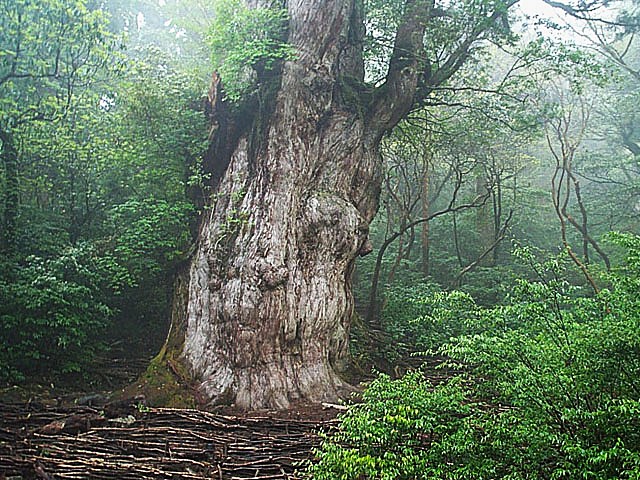
This post covers three more interesting aspects related to Kagoshima Prefecture at the southern end of Kyushu Island. First a look at the exotic cedar forests of Yakushima, some trees are over 5000 years old! Next, we go to the Satsunan islands south of Kagoshima City, which are known for their stunning beaches (said to rival the best of Okinawa, but without the crowds!). Finally, we look at the rebellious history of Kagoshima Prefecture from the 1850s to the fall of the Tokugawa Edo-Tokyo shogunate. Did you know that the Rebel Alliance in Star Wars was modeled by George Lucas on the Kagoshima rebels? And Darth Vader was none other than the Tokugawa shogun. Few people are aware that genius Japanese director Akira Kurosawa's samurai film, The Fortress, gave birth to Star Wars. Afterall, the light sabers used by the Jedi knights and the bad guys are nothing more than sci-fi samurai swords!
The rest of this post covers:
- Yakushima: Subtropical virgin cedar forest island
- The subtropical Satsunan islands south of Kagoshima
- How the Satsuma-Choshu Rebels beat the Tokugawa Darth Vaders
Content by Ian Martin Ropke, owner of Your Japan Private Tours (est. 1990). I have been planning, designing, and making custom Japan private tours on all five Japanese islands since the early 1990s. I work closely with Japan private tour clients and have worked for all kinds of families, companies, and individuals since 1990. Clients find me mostly via organic search, and I advertise my custom Japan private tours & travel services on www.japan-guide.com, which has the best all-Japan English content & maps in Japan! If you are going to Japan and you understand the advantages of private travel, consider my services for your next trip. And thank you for reading my content. I, Ian Martin Ropke (unique on Google Search), am also a serious nonfiction and fiction writer, a startup founder (NexussPlus.com), and a spiritual wood sculptor. Learn more!
Yakushima: Subtropical virgin cedar forest island
The legendary subtropical island of Yakushima is part of Kagoshima Prefecture. Yakushima is covered by an extensive virgin cedar forest that is home to some of Japan's oldest living trees. Trees more than 1,000 years old are affectionately called yakusugi (a combination of Yakushima and sugi, the Japanese word for cedar), the oldest are more than 7,000 years old.
The island's cedar forests were logged extensively in the past, particularly during the late feudal age for the production of cedar shingles. Today the forests have well recovered from past logging and are a national park, while some areas were declared a Natural World Heritage Site in 1993. Most tourists come to the island to hike through the ancient, moss-covered mountainous forests of the island.
Yakushima is known for its year-round rain. A local saying states that it rains "35 days a month on Yakushima." While that may be an exaggeration, it does rain nearly every day in the island's mountainous interior. At the highest elevations during the winter months the rain becomes snow!
Top attractions in Yakushima:
Jomonsugi: 5000 BC to early AD cedar tree forest: Scientists estimate that the giant Jomonsugi cedar tree is between 2000 and 7200 years old. It is thought to be the oldest tree in Japan, having originated during the Jomon Period, when it was given its name. It is about 25 meters high, but it has a huge trunk that is roughly 5 meters across. Loggers of the Edo Period likely found the Jomonsugi tree hundreds of years ago, and because of its irregular shape, it escaped logging like the other ancient cedars of Yakushima. When Yakushima's woodlands were declared a national park in the 1960s, it was rediscovered and has since been safeguarded. Wilson's Stump, the hollowed-out remains of a giant cedar felled three centuries ago, the Daiosugi (lit. Great King Cedar), one of the island's largest trees, and the Meotosugi, a pair of trees that resemble a husband and wife embracing, are among the other well-known trees on Yakushima that can be seen along the trail to the Jomonsugi. In order to finish before sunset, you need begin out before dawn for the about ten-hour round-trip climb. The Anbo Trail's first section of hiking follows a flat, rather easy railway that is little utilized. The second section of the Okabu Trail is frequently steep and consists of a mix of boardwalks, wooden steps, and dirt walkways. You can spend the night at Takatsuka Hut, which is located 200 meters past the Jomonsugi, if you'd rather go more slowly. A kilometer or so further down the Miyanoura Trail comes the larger Shin-Takatsuka cabin. There is no staff at either hut. Only at the huts and specific tent sites close to the huts is overnight camping allowed. Having the right equipment is crucial, just as on any hike. Hiking boots and good rain gear are highly recommended. You need to pack enough of water, food, and toiletries. The trailhead, the Okabu Trail entrance, and the Jomonsugi (toilets at Takatsuka Hut and water at the stairs before the tree) all have restrooms and water. There are guides available in both Japanese and English, although they are not necessary because the trails are clearly signposted in both languages. Nonetheless, the guides offer a wealth of knowledge regarding the ecology and history of the locations along the route.
Other attractions around the island:
Although most visitors travel to Yakushima to admire the cedar trees, the island offers much more than just trekking. Numerous additional outdoor attractions are also available, including as onsen, museums, waterfalls, scuba diving, snorkeling, and nature viewing. Driving around the island's perimeter is one of the greatest ways to observe it. Particularly along the western shore, where the UNESCO World Heritage Site stretches to the sea and the roads are too winding and narrow for the buses to operate, the rugged slopes and cliffs along some of the coast provide some great sights. On the island, you might come across wild Yakushima deer and monkeys, known locally as Yakushika and Yakuzaru, whether you're trekking or driving. Do not approach or feed the animals, as is the case in all national parks. Sea turtles land on Yakushima's western beaches in June and July to lay their eggs. There are guided tours available, but special care must be taken to observe them. The island is also home to a few hot springs, a couple are on the beach or within crawling distance. In the south, close to Yudomari, are the coastal baths of Hirauchi Kaichu Onsen. With the exception of a few hours before and after low tide, its baths are noteworthy since they are typically submerged.
Shiratani Unsuikyo: Miyazaki Princess Mononoke anime inspiration: The Nidaiosugi and Kugurisugi, the park's most accessible yakusugi, are among the many ancient cedars found in the verdant Shiratani Unsuikyo Ravine on Yakushima, which is only a fifteen-minute walk away. A well-liked spot to view the woodlands without doing much difficult hiking is Shiratani Unsuikyo. Along the ravine, there is a system of well-maintained hiking routes in the park. You are free to explore and pick your own course among the paths, but the suggested circuits range in duration from one to five hours. From a historic walk constructed during the Edo Period (1603-1868) to more advanced ones covered in stone and wood, the trails range in difficulty. There are signs in English everywhere. A section of the woodland that inspired the Studio Ghibli animated feature Mononoke Hime (Princess Mononoke) is one of Shiratani Unsuikyo's primary attractions. This is where the principal artist for the movie spent a lot of time sketching the forests. The Shirakami Sanchi Mountains in Akita Prefecture served as additional inspiration for the movie's mountains. The trail to Tsuji-toge Pass leads to the little grove at the park's far end. This trail will eventually get you to the Jomonsugi by connecting with the Anbo Trail approximately halfway to the Okabu Trail entrance. Compared to the path from the Arakawa Trailhead, the round-trip hike to the Jomonsugi is more challenging and takes around twelve hours.
Yakusugi Land: There are several yakusugi (Yakushima Cedars that are more than a thousand years old) in Yakusugi Land, a nature park, including the Buddhasugi, Futagosugi, and Sennensugi, as well as a number of well-maintained routes that wind among them. Since many of the old cedar trees are only a short stroll from the park entrance, it's one of the easiest places to see them on Yakushima. There are many hiking trails in the park that are suitable for hikers of almost any skill level. The suggested circuits all take the same path into the park, with distinct turnoff sites leading back to the trailhead, and range in length from 30 minutes to 2.5 hours. While the more challenging hikes continue farther into the forest along a variety of trails, the shortest route follows a boardwalk track that soon leads to the yakusugi. Reaching the summit of neighboring Tachudake is the longest route. English pamphlets are provided at the trailhead and there are English signage all across the park. The Kigensugi, another of Yakushima's enormous cedars, is a fifteen-minute journey further into the highlands from Yakusugi Land. The only yakusugi on the island that can be reached by car is this old tree, which is situated right next to the road.
The subtropical Satsunan islands south of Kagoshima
Amami Oshima is a wellknown subtropical island between Kagoshima and Okinawa. Amami Oshima is the largest island in the Satsunan island group, which stretches between Kyushu and Okinawa. The island bears a striking resemblance to the Okinawan Islands to the south in terms of its temperature, beaches, fauna, and vegetation, which includes mangrove forests and huge ferns. Beautiful beaches with white sand and warm, clear waters that are perfect for swimming in the summer are scattered around Amami Oshima's shoreline, drawing tourists there.
Compared to Okinawa, the island's beaches are typically less crowded, and while many of them are excellent for swimming and lounging, others also offer excellent snorkeling conditions. Amami Oshima boasts a distinctive cuisine, a rich human history, and stunning scenery. The island is also well-known for its prized Oshima Tsumugi silk, which has been used to create exquisite kimonos for decades. Amami Oshima often experiences its greatest weather from late June to August, just like Okinawa.
Part of the Satsunan island group, Tokunoshima is a subtropical island in Kagoshima Prefecture, located south of Amami Oshima. Tokunoshima is similar to the Okinawan islands in terms of climate, beaches, and vegetation, but being less promoted as a tourist destination. There are three major town centers on the island: Isen in the south, Tokunoshima in the east, and Amagi in the west, which is also home to the airport. Many of Tokunoshima's beaches, which are part of Amamigunto National Park, are very uncrowded, drawing tourists there. Similar to Okinawa, late June through October typically offers the best beach weather. Along with its beaches, the island is well-known for its "bull sumo" form of bullfighting and the June annual Tokunoshima Triathlon. Tokunoshima was once a part of the Ryukyu Kingdom, just as other islands in the area. It was included in the Satsuma Domain in 1624, which later evolved into the modern-day Kagoshima Prefecture. The renowned samurai Saigo Takamori (see below) was banished to Tokunoshima for two months in 1862 before being sent to Okinoerabu Island, which was farther south. The United States controlled Tokunoshima following World War II until 1953, when it was returned to Japan.
How the Satsuma-Choshu Rebels beat the Tokugawa Darth Vaders
In 1866, the southwestern feudal domains of Satsuma and Choshu created the strong military coalition known as the Satsuma–Choshu coalition in an attempt to topple the Tokugawa shogunate of Japan and restore Imperial rule. Just like the Star Wars story and the ultimate goal of the Rebel Alliance and its Jedi knights.
The names of two of the most powerful Imperialist tozama domains in Edo-period Japan, Satsuma (now Kagoshima Prefecture) and Choshu (now Yamaguchi Prefecture), are combined to form the acronym Satcho.
In the 1860s, Choshu (Yamaguchi Prefecture at the western tip of Honshu Island) had turned into the epicenter of an insurrection intended to topple the Tokugawa shogunate, whereas Satsuma preferred to adopt a moderate stance toward the preservation of the status quo. Sakamoto Ryoma of the Tosa Domain, which is now Kochi Prefecture in the southwest corner of Shikoku Island was also a key player in the rebellion against the Tokugawas of Edo.
Katsura Kogoro of the Choshu Domain was brought together with Satsuma military officers Okubo Toshimichi and Saigo Takamori. Despite their longstanding animosity, the leaders of the two domains decided that a change was needed and pledged to support one another in the event that a third party invaded either. Despite having relatively little touch with the western powers, Choshu was in dire need of modern armaments. However, through a Scottish businessman named Thomas Glover who was connected to the giant British Jardine Matheson trading company (Hong Kong based), Satsuma had established a sizable weaponry trade with the United Kingdom. Saigo assisted in negotiating an arrangement to provide Choshu with the armaments it required to combat the Tokugawa shogunate at Sakamoto's advice.
There was still a great deal of mistrust between the two realms in spite of this help. Choshu daimyo Mori Takachika was ordered to resign and be imprisoned by the Shogunate on March 1, 1866, and domain revenues were to be cut by 100,000 koku. The Choshu leadership became infuriated by this and formally reached a six-point agreement with Satsuma. The agreement's scope was somewhat constrained. Satsuma consented to help Chōshū get the Imperial Court to forgive him. Satsuma would deploy 2000 warriors to Kyoto if this failed and the Shogunate invaded; however, Satsuma would only fight the Shogunate if Kuwana, Aizu, or the personal guard of Shogun Tokugawa Yoshinobu tried to prevent Satsuma from reaching the Emperor.
In the summer of 1866, the Tokugawa shogunate launched a punitive expedition, which Choshu was able to repel thanks in large part to the Alliance. As a result, the Tokugawa soldiers suffered a crushing loss. Samurai from the Satcho alliance made up the majority of the imperial army that ultimately toppled the Shogunate during the ensuing Boshin War in 1868–1869. Men from these two fields controlled the new Meiji government into the 20th century after the Meiji Restoration was established.
The final escape by Saigo Takamori's Satsuma forces
Saigo Takamori, a national hero for his part in toppling the Tokugawa shogunate (after 267 years of domination), led a rather tranquil life after returning to Kagoshima. However, he was a natural focal point for opposition to the central government due to his enormous status and the complaints of disgruntled samurai who had either followed him from Tokyo or been disenfranchised by Meiji period reforms. He assisted in the founding of Kagoshima's shigakko, or private school system, in 1874. Despite being supposedly for education and military training grounded in ancient samurai ideals, these schools turned into hotbeds of anti-government sentiment and produced a generation of young men who were not only critical of the Tokyo authority but also strongly loyal to Saigo. Saigo was cautious of indiscriminate Westernization and the pursuit of "profit" over morality, but his educational system placed a strong emphasis on Confucian universalism, arguing that Japan could learn from the West while preserving its own traditions.
Throughout 1876, tensions between Satsuma and the Tokyo authorities increased. Samurai identity and privilege were severely damaged by the actions of the Meiji administration, which included the conscription of commoners, the conversion of samurai stipends into government bonds (Chitsuroku shobun), and the prohibition on the carrying of swords. Other sections of Japan saw the rise of rebellions by disgruntled samurai, such the Shinpuren Rebellion and the Saga Rebellion, which was led by Eto Shimpei. Although he was reluctant to spearhead an open uprising himself, Saigo observed these occurrences with conflicted feelings.
The situation in Kagoshima reached a crisis point in late January 1877. The central government tried to withdraw munitions from Kagoshima's armory because it was concerned about the Shigakko students' growing defiance and weapon accumulation. The Satsuma Rebellion was sparked by this deed as well as reports (later verified by a tortured confession) that government spies, including Nakahara Hisao, had been ordered to kill Saigo. Despite not having Saigo's explicit orders, the Shigakko students took control of the arsenal out of loyalty to him. Despite being horrified by what they had done, Saigo felt obliged to lead them and vowed to fight to the death. He declared his intention to march to Tokyo in order to "question" the central administration on February 7.
On February 15, 1877, the Satsuma army, which started out with about 12,000 men but lacked logistical support, started to march north. An imperial garrison defended Kumamoto Castle, which stopped their approach. The 54-day siege that followed was a crucial turning point because it gave the imperial administration the opportunity to raise a far larger and more capable national army. At the hard 18-day Battle of Tabaruzaka in March, the imperial army's superior artillery and supply lines proved decisive, and the rebels were soundly beaten.
The imperial army pursued Saigo's waning forces as they began a protracted and difficult retreat through Kyushu after being forced to lift the siege of Kumamoto in April. The insurgents were gradually defeated despite heroic combat and clever guerrilla warfare. With just a few hundred troops left, Saigo sneaked back into Kagoshima by early September and made a last stand on the Shiroyama Hill.
Shiroyama was the target of the imperial army's last attack on the morning of September 24, 1877. Saigo's soldiers were soon overrun, greatly outnumbered and outgunned. Saigo was shot during the battle and suffered serious injuries to his hip and abdomen. The most generally recognized stories and legends state that Saigo ritually committed suicide (seppuku) because he was unable to continue. "I think this place will do," he remarked, turning to face his close friend Beppu Shinsuke. Be my second (kaishakunin), please. Then, with a single blow of his sword, Beppu cut off Saigo head as he bowed his head quietly toward the Imperial Palace to the east Saigo's autopsy showed no abdominal incisions that would have been consistent with seppuku, indicating that he was probably too crippled by his bullet wounds to carry out the ritual and that Beppu beheaded him to avoid capture or a less respectable demise.
As is customary in samurai combat to deprive the victor a full victory, Saigo's manservant Kichizaemon concealed his head to keep it out of the hands of the opponent. Despite its modernity, the imperial army desperately looked for the head in observance of ancient martial traditions. Later that day, an imperial army soldier by the name of Maeda Tsunemitsu supposedly found it. After then, Saigo's head was abruptly reunited with his corpse, which was lying on a hill close to the barricades of the imperial army together with other rebel commanders.
- Indexed full list of all my blog posts | articles.
- Indexed full list of all my Japanese culture essays.
Content by Japan travel specialist & designer Ian Martin Ropke, founder & owner of Your Japan Private Tours (YJPT, est. 1990). I have been planning, designing, and making custom Japan private tours on all five Japanese islands since the early 1990s. I work closely with all of YJPT's Japan private tour clients and have a great team behind me. I promote YJPT through this content and only advertise at www.japan-guide.com, which has the best all-Japan English content & maps! If you are going to Japan and you understand the advantages of private travel, consider my services for your next trip to save time & have a better time. Ian Martin Ropke (unique on Google Search) is also a serious nonfiction and fiction writer, a startup founder (NexussPlus.com), and a spiritual wood sculptor. Learn more!