Japan private tours: Shikoku Island's Tokushima Prefecture Part 1
Tokushima Prefecture, on the eastern side of the island of Shikoku, is connected to the mainland by the Akashi-Kaikyo and Naruto Bridges. It takes two and a half hours to get there by highway bus from Osaka.
Tokushima Prefecture is known for its stunning but remote Iya Valley, a favorite destination for Japan private tour travelers. Your Japan Private Tours has designed and created more than a few Japan private tours that included Tokushima Prefecture. It should be noted that train travel is limited in the prefecture, and we recommend Japan private tour clients to consider using taxis to see as much of the prefecture as possible without stress.
The rest of this post covers:
Content by Ian Martin Ropke Japan travel expert since 1990. I have been planning, designing, and making custom Japan private tours on all five Japanese islands since the early 1990s. I work closely with Japan private tour clients and have worked for all kinds of families, companies, and individuals. Clients find me mostly via organic search, and I advertise my custom Japan private tours & travel services on www.japan-guide.com, which has the best all-Japan English content & maps in Japan! If you are going to Japan and you understand the advantages of private travel, consider my expert Japan travel services for your next trip. And thank you for reading my content. Learn more!
Tokushima Prefecture's remote Iya Valley
Tokushima Prefecture's western region is famous for the attractions of the remote Iya Valley. The valley, which is in the center of Shikoku Island, is distinguished by deep rocky canyons and steep mountain slopes that were previously traversed by vine bridges. Even today, three of the bridges remain intact and are among the region's most visited sights. Iya is also well-known for its outdoor sports, hot springs, and hiking.
The valley's isolation has made it a haven for Taira Clan members who fled to the area following their defeat in the Gempei War (1180–1185) near the close of the Heian period. Hundreds of years later, their descendants are still present in the Iya Valley and other isolated areas of Japan.
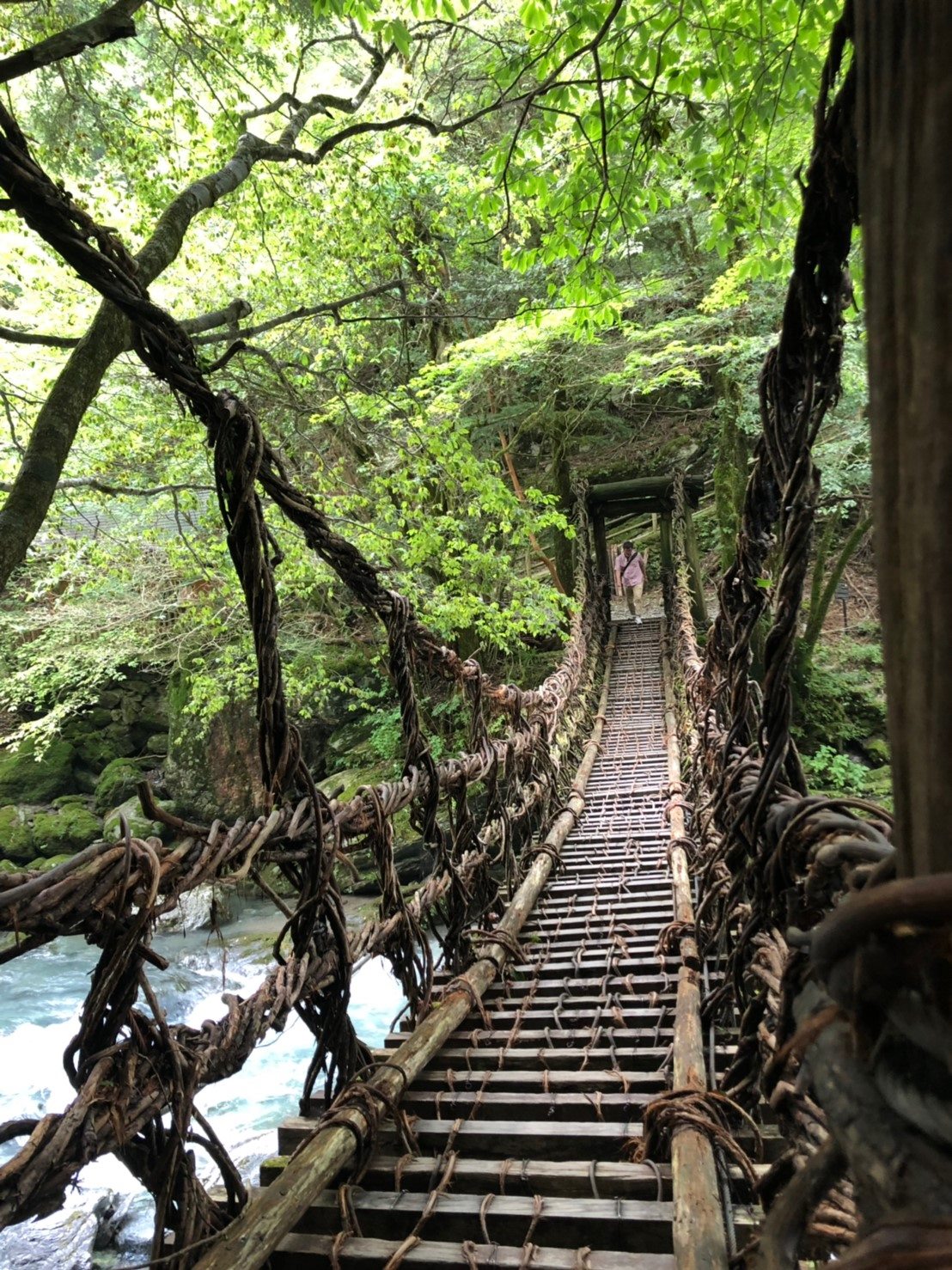
In the past, the Iya Valley had thirteen suspension bridges constructed of mountain vines, or kazurabashi, which served as an essential way to transport people and products across the river. Two of the remaining bridges, the Oku-Iya Kazurabashi bridges, are next to each other.
Husband Bridge (Otto no Hashi), the largest of the two bridges, crosses the river next to a small waterfall. The Wife Bridge (Tsuma no Hashi), which is slightly lower, crosses the river further upstream. Every three years, the bridges are reconstructed using steel cables that are concealed among the vines. A system of paved hiking paths connects these bridges, and on the opposite side of the river, there are camping areas.
Adjacent to the Wife Bridge lies Wild Monkey Bridge, another popular destination. It is a hanging wooden cart that was used to move people and things across the river. Visitors can pull themselves across the river on these wooden carts.
The Iya River cuts through the Iya Valley. A twisting, often narrow mountain road winds through the valley, connecting its steep forested slopes to the outer world. Even though the Iya Valley's deeper regions can be challenging to reach, tourists are drawn to the region because it offers a traditional, rural lifestyle that is hard to find in near Japan's big cities.
The author of "Lost Japan," Alex Kerr, has been promoting the Iya Valley since the early 1970s. In order to show guests to traditional Japanese life, he purchased and renovated an old farmhouse called Chiiori, which is now used as a lodging establishment. In a settlement along the steep valley, Kerr later helped open the Togenkyo Iya, a collection of restored traditional dwellings.
The Iya Valley is separated into two regions. The valley's main entrance, Nishi Iya (West Iya), is a little more developed and easier to get to. Farther back in the valley, Oku Iya (Inner Iya, also known as Higashi Iya or East Iya) is challenging to get to without a rental car or hired taxi.
Nishi Iya (west side of the Iya Valley)
Manikin Peeing Boy Statue: The statue of a child standing on the edge of this frightening 200-meter-high cliff is positioned as though he is urinating off the ledge and into the valley below. The statue is situated in a picturesque area a short distance from the Iya Onsen Hotel, where, according to local legend, brave travelers would climb to and pee. Visitors are deterred from trying this risky deed today by a railing.
Iya Onsen Hotel: The legendary Iya Onsen Hotel sits high on the steep slope with killer views across the Iya Valley. A steep cable car connects the hotel to it's outdoor hot spring spas, which are situated along the river some 170 meters below the hotel itself.
Shin-Iya Onsen Hotel Kazurabashi: The Hotel Kazurabashi at Shin-Iya Onsen features three outdoor baths with pleasant views of the Iya Valley, one for each gender and one for both. A quick cable car journey will get you to the spas, which are located well above the hotel on the slope.
Higashi Iya History and Folk Museum: At the entrance to Oku Iya is a small historical museum called the Higashi Iya History and Folk Museum. The museum has excellent displays and exhibits of tools, clothing, household goods, and other traditional objects that were used by the inhabitants of the Iya region in centuries past.
Samurai House: This restored samurai residence high up in the valley's steep slopes is the former home of the Kita Clan's daimyo lords. In addition to equipment and implements required for day-to-day living in this isolated village, it showcases a set of samurai armor. The closest bus stop is approximately a 45-minute from the village.
The Iya Valley's remarkable Kazurabashi Bridges: In the past, the primary way for people to cross the Iya Valley's river was via suspension bridges constructed from mountain vines, or kazurabashi. Although their origins are unknown, legend has it that they were either created by Heike refugees who were hiding in the area following their defeat in the Gempei War (1180–1185) as a means of rapidly cutting off access to the valley, or that they were first built by Kobo Daishi, founder of the Shingon Sect of Japanese Buddhism (and the inspiration behind Shikoku's 88-temple pilgrimage). There used to be thirteen bridges that crossed the valley, but now there are just three. The longest and most well-known of the remaining bridges, Iya Kazurabashi, spans the Iya River, 14 meters above the river's flowing waters. Rebuilt every three years, the bridge is secured to large cedar trees on both ends, with steel cables concealed amongst the vines. The bridge is illuminated nightly between 19:00 and 21:30.
The wild & pristine Oboke & Koboke gorges
The narrow, steep-sided gorges just west of the main Iya Valley entrance are known as the Oboke Gorge and Koboke Gorge. They are known as "big dangerous steps" and "small dangerous steps" because of their rocky, jagged walls, which can be dangerous to cross. These gorges were made by the Yoshino River's powerful rapids.
The gorges are one of Japan's top outdoor destinations. They are renowned for their stunning natural surroundings and the range of outdoor pursuits they offer, including canyoning and whitewater rafting.
Oboke Sightseeing Boat Cruise: On this cruise, guides point out intriguing rocks along the route, many of which look like animals, during this leisurely 30-minute boat journey down the Yoshino River. During the cruise, passengers sit on the boat's floor after taking off their shoes.
Lapis Oboke: A tourist information center, café, shop, and a humorous little Yokai Museum with models and dioramas of the ghosts and monsters (yokai) that are part of the local legend can be found at Lapis Oboke, a rest area (Michi no Eki) next to Oboke Station. There is a small gem museum on the second floor.
River Rafting: Numerous outdoor adventure businesses provide guided tours on the Yoshino River, which is one of the most popular whitewater rafting destinations in Japan. In addition to rafting programs that last half or full days, travelers can experience other adventure sports like stand-up paddleboarding and canyoning.
Mount Tsurugi
The eastern end of the Iya Valley is home to the 1,955-meter-tall Mount Tsurugi. Mount Tsurugi, the second-highest mountain on Shikoku, is a focal point of Shugendo, a folk religion centered on mountain worship, and is listed among the "100 Famous Mountains" of Japan. Despite its moniker, which means "Sword Mountain," it is a great hiking destination and is not a difficult ascent.
Visitors can ascend the mountain to a station close to the summit on a leisurely chairlift. The most direct trek to the summit from there takes between 30 to 45 minutes, while a somewhat longer alternative path via Otsurugi Shrine is also an option. A shrine, mountain huts, weather towers, and wooden boardwalks leading to several vantage spots with expansive views of the neighboring mountains may all be found at the summit.
From the trailhead at Mi no Koshi, close to the lower chairlift station, more committed hikers can ascend the entire mountain. It takes roughly two hours to trek uphill.
- Indexed full list of all my blog posts | articles.
- Indexed full list of all my Japanese culture essays.
Content by Ian Martin Ropke Japan travel expert since 1990. I have been planning, designing, and making custom Japan private tours on all five Japanese islands since the early 1990s. I work closely with Japan private tour clients and have worked for all kinds of families, companies, and individuals. Learn more!