Tourist-perfect Ishikawa Prefecture rivals crowded Kyoto and Takayama
Before we get into today's post about Ishikawa Prefecture's capital city Kanazawa, some breaking news about teamLab's newest location in Kyoto.
teamLab Biovortex Kyoto, scheduled to open on Oct. 07, is located southeast of Kyoto Station, in the city’s Southeast Kyoto Station Area Development Project. Believe it or not, teamLab Kyoto is the biggest teamLab museum in all of Japan.
teamLab Biovortex Kyoto was designed around the idea of "Environmental Phenomena." Most the installations are made of air, light, water and bubbles, which change shape and form continuously.
teamLab Kyoto features three interactive, educational zones designed for families: Athletics Forest, Future Park, and the Sketch Factory.
For tickets visit the teamLab Biovortex Kyoto’s website: https://www.teamlab.art/e/kyoto/.
Ishikawa Prefecture is located on the Sea of Japan coast about 2 hours northeast of Kyoto (and two hours by Hokuriku bullet train from Tokyo). The prefecture’s capital is Kanazawa City or the Little Kyoto, which is one of the Japan’s most popular tourist destinations for all kinds of reasons. Kanazawa and Ishikawa Prefecture is famous in Japan for its sophisticated 30-year (and ongoing) local tourist promotion campaigns in Tokyo and the Kyoto-Osaka region, which are both only two hours away by train! Beyond, Kanazawa City, travelers continue to explore the amazing charms of the remote and rugged Noto Peninsula (the center of Japan’s traditional lacquer industry) and relax in the hot waters of the Kaga Onsen area.
The rest of this post covers:
Japan private travel content by Your Japan Private Tours' (established in 1990) founder Japan travel expert Ian Martin Ropke. I have been planning, designing, and making custom Japan private tours on all five Japanese islands since the early 1990s. Your Japan Private Tours specializes in bespoke travel for private clients (I do not work with agents) including exclusive excursions, personalized experiences, and unique adventures. I am 100% client-centric and total individual attention. Consider my Japan travel services for your next trip. And thank you for reading my content. Learn more!
Ishikawa Prefecture's capital Kanazawa City aka Little Kyoto
Kanazawa City, long the capital of the Ishikawa Prefecture region, has promoted itself better than any other city in Japan for a long time now. I remember going to work in Osaka in the 90s and the train cars were full of colorful historical ads promoting Kanazawa City. In fact, the city is often referred to as the Little Kyoto. And little it is. Kanazawa has less than 500,000 inhabitants while Kyoto is over 1.5 million. And this gives travelers advantages that Kyoto doesn't have. Kanazawa is perfect for all-day strolling or all-day biking, or you can just hop on and off the city's tourist buses. Either way, Kanazawa is on the Golden Route linking Tokyo with Kyoto for most foreign travelers (and the city also attracts enormous numbers of domestic Japanese travelers).
In the Edo Period (1603-1868), Kanazawa City was the powerbase of the Maeda Clan and their impressive castle (now being reconstructed). The Maeda samurai clan were the richest and most powerful after the Edo-Tokyo Tokugawa shogun base. Kanazawa was super rich in rice and the Maeda's spent their fortunes making the city a rival to Kyoto and Edo.
In WWII, Kanazawa, like Kyoto, avoided mass destruction from the Americans because it had no major war-related industry. So, when the war was over, Kanazawa still had all of its ancient cultural and historical attractions. The city is also the only place outside of Kyoto where traditional geisha culture continues to survive.
High-value private tour destinations in Kanazawa City, Ishikawa Prefecture:
Kanazawa's 400-year-old Omicho Market: Kanazawa's Omicho Market fresh food market has been in operation for hundreds of years and when you visit you can feel the history and bustle. The market is now a warren of covered, mostly car-free lanes where the region's best seafood and produce are sold. The market is also a place to buy knives, things for the kitchen, clothing and other traditional items. The best time to visit is at dawn before it gets too crowded but some people like crowds. The market's local specialty is seafood domburi rice bowls, which you can enjoy all day long. Get there early and savor this ancient market world.
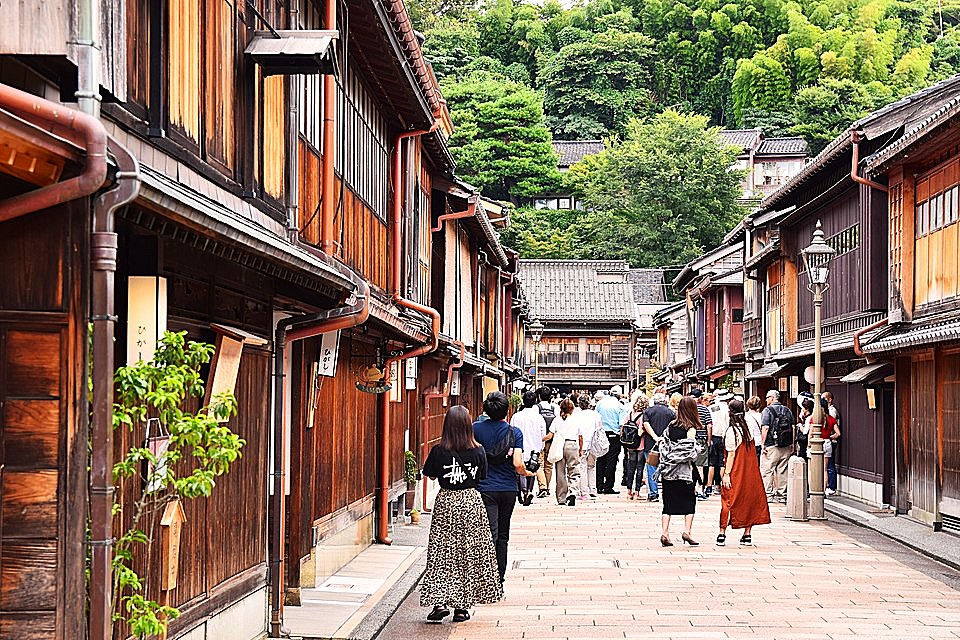
The Higashi Chaya District's preserved geisha charms: Chaya is the Japanese word for a teahouse and teahouses are where geisha culture entertains the clients with song and dance. Teahouses are not walk in establishments. You have to have a reservation or high-level connections to "play" in the chaya geisha world. Kanazawa has three preserved chaya districts: the eastern Higashi Chaya District, the western Nishi Chaya District, and Kazuemachi along the river. The Higashi Chaya district is Kanazawa's largest and most developed teahouse area. Two chaya, the Kaikaro Teahouse and the Shima Teahouse, are open to tourists. Though teahouse areas are mostly alive and active at night, modern tourism has resulted in all kinds of day-time attractions ranging from restaurants and cafes to shops catering to tourists. Strolling the streets of Kanazawa's Higashi Chaya district is a walk into the past and the future.
Kenrokuen Garden is Japan's best: Kanazawa's Kenrokuen garden is considered to be the finest Japanese stroll garden in Japan. The gardens were built with the immense fortune of the Maeda Clan samurai lords, over a 200-year period, and have stood the test of time. Kenrokuen only opened to the public in 1871. Before that the garden was the exclusive domain of the Maeda samurai lords and their "friends." The garden's grounds are vast and home to many ponds, streams, bridges, huge stones and teahouses.
Seisonkaku Villa is samurai luxury living: The Seisonkaku Villa, on the south side of the Kenrokuen Garden complex, was constructed at the end of the Edo Period by a Maeda samurai lord. It remains one of Japan's most celebrated samurai villas.
Ninjadera and its secrets: Ninjadera Temple or Myoryuji Temple was also built by Kanazawa's samurai lords during the Edo Period. The Ninja connection is really about the secret things the Maeda lords included in the temple structures. Though a temple, Ninjadera was really a Edo-Tokyo shogun military outpost (like Kyoto's Nijo Castle). Ninjadera is super popular with tourists, and you have to reserve in advance to see its secret rooms, tunnels and traps. Once inside it's almost impossible to orient yourself and this was part of the original design (i.e., confuse the enemy).
Nishi Chaya District, small and quiet: The Nishi or western teahouse district of Kanazawa is near Ninjadera. It covers a small area and attracts much less tourism than the Higashi eastern chaya district, but it is well worth visiting all the same.
Nagamachi samurai town: Every great samurai city has its own samurai district. Kanazawa's Nagamachi is located on the western edge of the Kanazawa Castle precinct. It was the home of samurai warriors and their family's during the Edo Period. The area is well preserved and great for strolling. The local eye candy includes great samurai residences, ancient earthen walls, car-free lanes, and lovely canals. In addition to the samurai residences open to tourists, do consider the Ashigaru Shiryokan Museum. Samurai ashigaru foot soldiers were the lowest and poorest rank in samurai times, but they were important (just like ponds on a chess board).
Kanazawa's 21st Century Museum: Kanazawa's 21st Century Museum of Contemporary Art is nextdoor to the Kenrokuen Garden complex. The uniquely circular museum opened in 2004 and has been a national sensation ever since. The museum was designed to be part art museum and part community space (including a library and workshop spaces). The rotating and permanent exhibits feature both celebrated Japanese and foreign artists.
- Indexed full list of all my blog posts | articles.
- Indexed full list of all my Japanese culture essays.
Japan private travel content by Your Japan Private Tours' (established in 1990) founder Japan travel expert Ian Martin Ropke. I have been planning, designing, and making custom Japan private tours on all five Japanese islands since the early 1990s. Your Japan Private Tours specializes in bespoke travel for private clients (I do not work with agents) including exclusive excursions, personalized experiences, and unique adventures. I am 100% client-centric and total individual attention. Consider my Japan travel services for your next trip. And thank you for reading my content. Learn more!