Japan private tour insights for Osaka Prefecture's Osaka City
Osaka Prefecture for most travelers is really Osaka City, which is the third largest city in Japan (after Tokyo and Yokohama). However, there are other places in Osaka Prefecture that merit a visit including Sakai City (known for its ancient tumuli and blacksmith culture) and the hot spring resort area in the northwestern corner of the prefecture. Learn more!
The rest of this post covers:
Japan private travel content by Your Japan Private Tours' (established in 1990) founder Japan travel expert Ian Martin Ropke. I have been planning, designing, and making custom Japan private tours on all five Japanese islands since the early 1990s. Your Japan Private Tours specializes in bespoke travel for private clients (I do not work with agents) including exclusive excursions, personalized experiences, and unique adventures. I am 100% client-centric and total individual attention. Consider my Japan travel services for your next trip. And thank you for reading my content. Learn more!
Osaka City private tour insights & tips
During the Jomon period (7,000 BC), present-day Osaka one of the first places where the Japanese people settled. The area had abundant fresh water and was easily defended. At the beginning of the third century AD Sumiyoshi Grand Shrine was built near the ancient harbor of Osaka on the orders of Empress Jingu.
By the Kofun period (300 to 538 AD), Osaka was a key hub port connecting the region to Kyushu island (where Japanese civilization first began). In the Kofun period, Naniwa or Osaka became Japan's first centralized capital. It was Japan's biggest trading center.
In the 16th century, Toyotomi Hideyoshi chose Osaka as the location for his castle, the biggest one ever built in Japan. Toyotomi, a quasi shogun, invaded Korea twice before he was overthrown by Tokugawa Ieyasu, who created the new center of Japan in Edo (Tokyo).
From the late 19th century until the late 1970s, Osaka was the most powerful industrial and trading center in Japan. And this made Tokyo jealous in more ways than one!
Osaka Castle: Toyotomi Hideyoshi, a quasi shogun at the end of the 16th century, began building Osaka Castle in 1583 on the site where powerful Ishiyama Honganji Temple once stood (until it was destroyed by Oda Nobunaga in 1570). Osaka Castle was the largest feudal castle ever built in Japan (the current reconstruction is only 2/3rds of the original). The castle was largely destroyed in 1615 by Tokugawa Ieyasu's Edo-Tokyo troops. It was rebuilt by Ieyasu's son in the 1620s. The castle was struck by lightning in 1665 and was only rebuilt in 1931! Though mostly made of concrete Osaka Castle continues to fascinate tourists because it was so incredibly large and influential in Japanese history. On weekends in peak season (March, April and October, November), it can take a while to get into the castle. Getting e-tickets online is highly recommended. Osaka Castle Park is huge (two square kilometers) and super popular during cherry blossom season.
Sumiyoshi Taisha: Osaka's Sumiyoshi Taisha, dating to the third century AD, is one of the oldest Shinto shrines in Japan. It is the mother shrine of hundreds of Sumiyoshi shrines across the country. The architectural style of Sumiyoshi shrines is purely Japanese as it pre-dates the introduction of Buddhism and Asian building styles in the 6th century. Sumiyoshi shrines are home to the kami or Shinto gods that protect fishermen, sailors, and sea travelers. Osaka Sumiyoshi Shrine is one of the most visited shrines in the nation during Japanese New Year (January 1, 2, 3).
Shitennoji Temple: Shitennoji Temple is one of the oldest in Japan. It was founded by Prince Shotoku less than 40 years after he introduced Buddhism at Nara's Horyuji Temple (during the Asuka period), which has some of the oldest extant wooden buildings in the world. The temple was destroyed by fire numerous times but always rebuilt. The temple's treasure house is well worth visiting for its deep collection of ancient paintings, manuscripts, and artifacts.
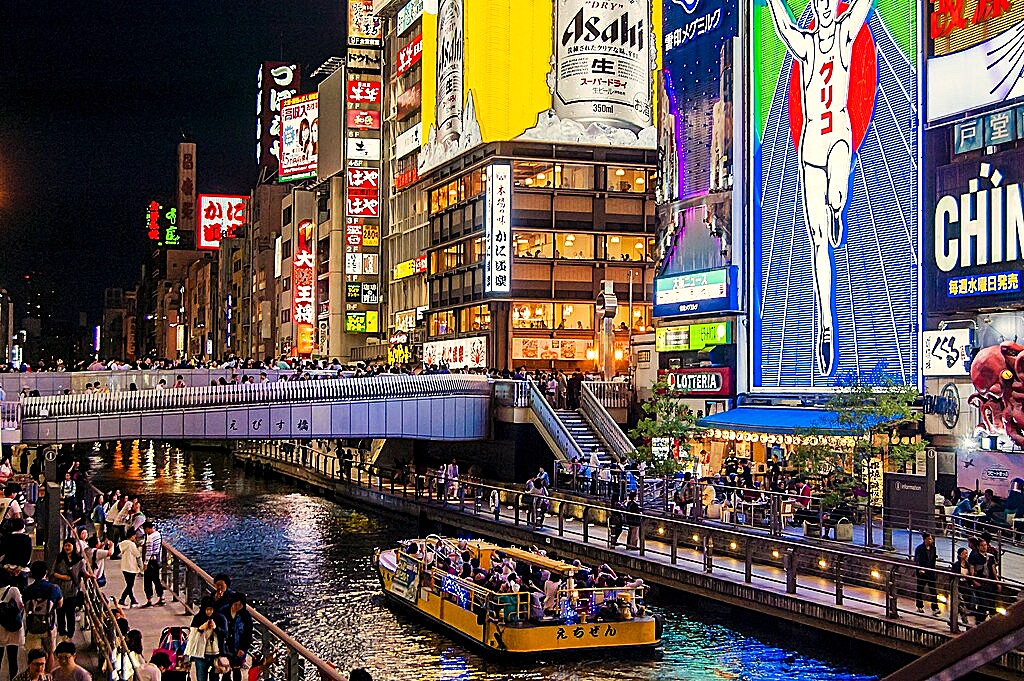
Dotonbori Canal area: Osaka’s Dotonbori district is the vibrant, pulsating heart of Osaka’s famous “food and fun” philosophy. This bustling entertainment district, centered around the Dotonbori Canal, offers visitors an unforgettable sensory experience. Dotonbori's colorful history began in 1612 with an ambitious canal project that would shape the district's future. In 1621, the Edo-Tokyo Tokugawa Shogunate designated Dotonbori as Osaka's official entertainment and redlight district. During the Edo period the Dotonbori area was the place to go to see wild kabuki plays, bunraku puppet theatre and eat all night long. Today, the area is one of Japan's best for foodies. Dotonbori is synonymous with Osaka’s reputation as “Japan’s kitchen.” The district embodies Osaka's kuidaore culture, which means eating and partying until you ran out of money.
Amerika Mura: Amerika Mura is a vibrant hub of Western-oriented youth culture centered around Shinsaibashi's popular Sankakukoen Triangle Park. This is a great destination for street art, street food and small galleries and cafes. And the district's numerous retro stores sell vintage clothing and secondhand books and records. At night the area's bars and clubs come alive with the latest trends in music and dance, especially hip-hop.
Shinsekai: Osaka's colorful Shinsekai (literally "New World") district was born from Japan's super successful 1903 National Industrial Expo. After the Expo the park was repurposed as an amusement park of sorts. The northern section was modeled on Paris with the Tsutenkaku Tower as a copy of the Eiffel Tower. The southern section of the area was inspired by New York's Coney Island. Today, Shinsekai continues to attract young and old for the food stalls and the overall carnival-like atmosphere. A number of the park’s restaurants specializing in kushikatsu or skewered deep fried foods are open 24/7. Shinsekai's huge Spa World bathing complex continues to be a popular city hot spring location.
Abeno Harukas: Abeno Harukas, a short stroll southeast of Shinsekai, was Japan's tallest skyscraper from 2014 to 2023. The structure is 300 meters high and home to a department store, an art museum, a hotel and super popular observation deck. The Harukas 300 observation deck takes up the buildings top three floors. The highest floor, floor 60, is made of massive floor-to-ceiling glass panels. Needless to say, the shopping opportunities at Abeno Harukas are almost endless, making it especially popular with tourists from Southeast Asia.
Minoo Park: Minoo Park lies in a forested valley on the northwestern edge of the city. The park is the perfect destination in all seasons for its fresh air and nearly endless green landscapes. It is one of the most famous places in Western Japan for autumn momiji maple leaf viewing. Minoo was accorded quasi-national park status in 1967 and is super popular as an easy hiking destination for Kansai's city dwellers.
Osaka's National Bunraku Theater: Osaka is the defacto center of Japan's Bunraku puppet theater tradition. Bunraku like kabuki was an entertainment form for the general public unlike the aristocratic Noh theater tradition. been the capital for bunraku, traditional Japanese puppet theater, for many centuries. Osaka's National Bunraku Theater is one of two Bunraku puppet theatres in Japan, the other being in Tokyo. And no need to worry about language as the theatre offers English programs and earphones.
Museum of Oriental Ceramics, Osaka: This specialized museum, located on the river on Nakanoshima Island, was originally set up to house the extensive collection of East Asian ceramics accumulated by the now-defunct Ataka trading company. The museum collection consists of several thousand pieces of Japanese, Chinese and Korean ceramics and pottery, including two of Japan’s designated National Treasures. It is a must-see destination for pottery and ceramic fans.
Kuromon Market: Osaka's Kuromon fresh food and produce market is a testament to the city's ancient food traditions (the market was established in the Edo period, nearly 400 years ago!). The covered market is almost 600 meters in length and home to over 150 shops selling seafood, meat, local produce, traditional Japanese sweets. A stroll down the Kuromon market is similar to a walk along Kyoto's Nishiki market. Lots of foods to sample for free and exceptional for people watching all day long!
Osaka Expo 70 Park: Osaka's Expo '70 Commemorative Park is a large public park about half an hour north of Osaka Station. The park was developed as the site for the highly successful 1970 Japan World Exposition (the first ever in all of Asia at a time when Japan was quickly becoming a global economic power). Today, the park is popular in all seasons for its vast green areas and attractions (sports facilities, museums, and botanical landscapes). The park's National Museum of Ethnology is home to many ethnological artifacts from all over the world. The nearby Japan Folk Crafts Museum is notable for its deep collections of Japanese textiles, ceramics, and other craft traditions.
- Indexed full list of all my blog posts | articles.
- Indexed full list of all my Japanese culture essays.
Japan private travel content by Your Japan Private Tours' (established in 1990) founder Japan travel expert Ian Martin Ropke. I have been planning, designing, and making custom Japan private tours on all five Japanese islands since the early 1990s. Your Japan Private Tours specializes in bespoke travel for private clients (I do not work with agents) including exclusive excursions, personalized experiences, and unique adventures. I am 100% client-centric and total individual attention. Consider my Japan travel services for your next trip. And thank you for reading my content. Learn more!