Osaka Prefecture travel tips Part 2: Sakai City & the Tempozan waterfront
Osaka Prefecture is both one of Japan's oldest civilized places and one of its most modern.
In ancient times, the area was home to Japan's first centralized capital cities (Naniwa) and also Sakai City's mysterious Mozu or keyhole kofun tumuli.
In modern times, Osaka City has gained considerable international attention for its amazing civil engineering projects (the man made island of Osaka KIX international airport), and the city's deep contemporary entertainment attractions (including Universal Studios Japan, a major aquarium, and Legoland).
The rest of this post covers:
- Sakai City: Ancient tumuli, blacksmith expertise, and bicycle maker
- Osaka City's waterfront entertainment zone built on reclaimed land
Japan private travel content by Your Japan Private Tours' (established in 1990) founder Japan travel expert Ian Martin Ropke. I have been planning, designing, and making custom Japan private tours on all five Japanese islands since the early 1990s. Your Japan Private Tours specializes in bespoke travel for private clients (I do not work with agents) including exclusive excursions, personalized experiences, and unique adventures. I am 100% client-centric and total individual attention. Consider my Japan travel services for your next trip. And thank you for reading my content. Learn more!
Sakai City: Ancient tumuli, blacksmith expertise, and bicycle maker
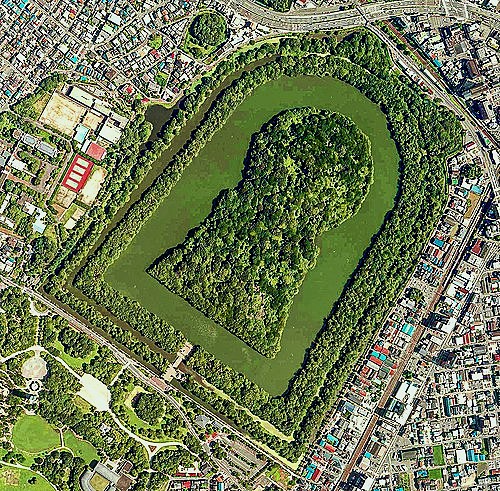
Sakai City is located south of Osaka City, just north of Osaka KIX international airport (Japan's third biggest arrival airport after Tokyo's Narita and Haneda airports). Sakai served as one of Japan's biggest and most important seaports during the medieval era (1185-1603 AD). This city is also famous for its keyhole-shaped kofun burial mounds dating from the fifth century. The Daisen Kofun is the largest grave by area in the world! Sakai was, and still is, a leading center for blacksmith products (swords and knives).
Medieval Sakai was an independent or "free city" run by a powerful merchant class. Ikkyu, Japan's infamous Zen priest chose to live in Sakai because of its free-thinking atmosphere. During the Muromachi and Sengoku periods (roughly 1450-1600), Sakai was one of the richest cities in Japan and much of that wealth came from foreign trade. It was a major center for textile production and ironwork.
Sen no Rikyu, known as the "father" of the Japanese tea ceremony was born into a Sakai merchant family. And Sakai was for the longest time the second most important Japanese tea ceremony center in Japan (after Kyoto, the imperial capital).
In the Sengoku period (1467-1590), many Christian missionaries, including Francis Xavier, entered Japan via the port of Sakai. One missionary, Gaspar Vilela, wrote that the city "governed by consuls like Venice."
Europeans introduced Japan's first matchlock firearms to the merchants of Sakai who quickly learned how to produce them at scale. European firearms were probably the biggest influence in the new castle designs of Japan that are so popular with foreign tourists today.
During the Westernization of Japan from 1868 onwards, Sakai became an industrial center for textile and brick manufacture. And during World War II, the city produced many of Japan's rifles. After the war, the rifle manufacturing expertise of Sakai was transformed into one of the biggest bicycle production centers in the world (Shimano bicycle corporation is based in Sakai!).
Sakai's 1600-year-old Mozu keyhole tumuli
More than 20,000 kofun tumuli were built across the Japanese archipelago. These unique funerary mounds contain human remains buried alongside grave goods made of iron, weapons and horse ornaments made of gilded bronze. The huge mounds of earth and stone of these kofun were erected over the graves of the ruling class. These tombs were huge mounds of earth created by countless workers. And many of the big tombs are surrounded by wide, deep protective moats.
The massive above and below ground Mozu Tombs (or keyhole tumuli) of Sakai were between the 4th and 6th centuries for the ruling elite. Sakai's Mozu kofun come in many shapes and sizes ranging from simple circular or square tombs to the bigger keyhole-shaped tombs. Emperor Nintoku's Kofun huge moated tumulus is roughly 800 meters long and 600 meters wide.
Of the original 100 Mozu tombs 44 remain. Of these, 19 have been designated as national historic sites. Japan's Imperial Household Agency has named three of the Sakai tombs as Imperial mausoleums. The Mozu tomb area became a UNESCO World Heritage Site in 2019.
Given their size it is impossible to get a bird's eye view from the ground. However, a free observation deck on the upper floor of modern Sakai City Hall does provide a good aerial view. Many of the area's medium and small sized kofun tombs located in the precincts of Daisen Park. And balloon rides from the park also provide excellent aerial views.
Note: The Furuichi tomb cluster, located about 10 km from the Mozu cluster, is home to Japan's second largest kofun tomb and eleven other keyhole-shaped tombs.
Osaka City's waterfront entertainment zone built on reclaimed land
Osaka's waterfront area facing Osaka bay, mostly built on reclaimed land, is home to many modern attractions including Universal Studios Japan, the Osaka Kaiyukan aquarium, and the Tempozan Ferris wheel.
Osaka's Chuo subway line connects Tempozan Harbor Village with central Osaka. The district, centered around Tempozan Marketplace, offers modern shopping malls and entertainment facilities. It is a medium-sized mall around which a Ferris wheel and aquarium are located.
The Osaka Aquarium (Kaiyukan) has a massive tank that holds 5,400 tons of water, one of the largest in the world, which is home to the rare whale shark.
The Tempozan Ferris wheel, located just next to the Tempozan Marketplace and Osaka Aquarium, offers riders excellent panoramic views of the Osaka Bay area and the city's skyscraper clusters.
Mount Tempozan, Japan's smallest mountain, is located next to the Tempozan Ferris wheel. It is a large park full of benches and walkways.
The Nanko Bird Sanctuary is also noteworthy. It was constructed on the northwestern corner of Sakishima Island for migratory birds.
- Indexed full list of all my blog posts | articles.
- Indexed full list of all my Japanese culture essays.
Japan private travel content by Your Japan Private Tours' (established in 1990) founder Japan travel expert Ian Martin Ropke. I have been planning, designing, and making custom Japan private tours on all five Japanese islands since the early 1990s. Your Japan Private Tours specializes in bespoke travel for private clients (I do not work with agents) including exclusive excursions, personalized experiences, and unique adventures. I am 100% client-centric and total individual attention. Consider my Japan travel services for your next trip. And thank you for reading my content. Learn more!