Japan private tour insights for Okayama Prefecture Part 1
Okayama Prefecture is mostly rural and relaxed and has excellent access to the Inland Sea. It has a warm climate and is a great destination in any season.
The capital of the prefecture is Okayama City, which is a bullet train station and also the transfer station for going to Shikoku Island. Okayama City is also home to one of Japan's most famous samurai stroll gardens (Korakuen Garden). I wouldn't sleep in the city as there are much better basecamps nearby.
My favorites places in Okayama Prefecture are Kurashiki (historic early-20th-century museums and canals) and Takahashi (great mountaintop castle and samurai-merchant town), which are both covered in this blog post. Learn more!
The rest of this post covers:
- The canals, kura storehouses and museums of Kurashiki
- Takahashi's off-the-beaten-track castle and samurai-merchant worlds
Japan private travel content by Your Japan Private Tours' (established in 1990) founder Japan travel expert Ian Martin Ropke. I have been planning, designing, and making custom Japan private tours on all five Japanese islands since the early 1990s. Your Japan Private Tours specializes in bespoke travel for private clients (I do not work with agents) including exclusive excursions, personalized experiences, and unique adventures. I am 100% client-centric and total individual attention. Consider my Japan travel services for your next trip. And thank you for reading my content. Learn more!
The canals, kura storehouses and museums of Kurashiki
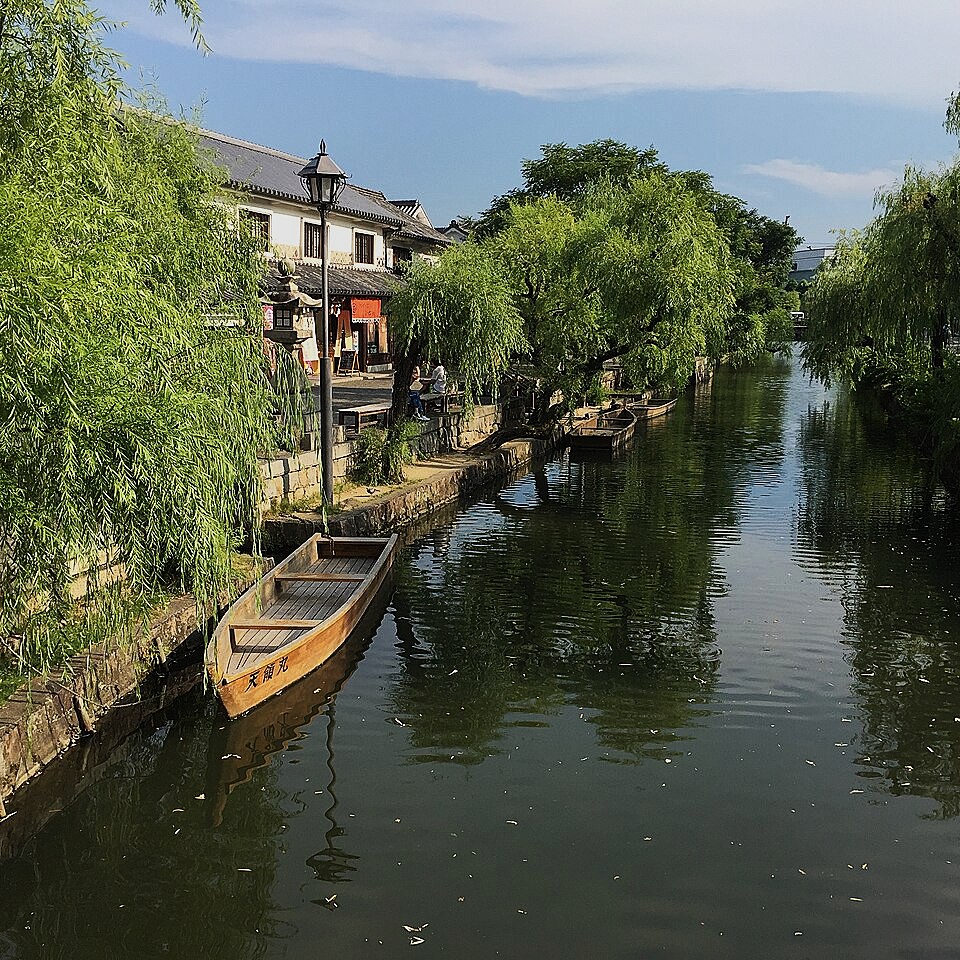
Kurashiki was an important center for rice distribution in the Edo period (1603-1867). The rice was collected in Kurashiki and then sent on to Osaka and Edo (Tokyo). The rice was transported via a canal system, which gives Kurashiki such a charming appearance today. The old town's canals are lined with lovely willow trees. Kura are Japan's distinctive white fireproof storehouses, with walls that are nearly 40 centimeters thick. They were used to store valuables such as rice and kimono and lacquer and gold because they were fireproof. Kurashiki has many old, large rice kura that have been converted into exhibition spaces, boutiques, and restaurants.
Kurashiki's historical canal area is a 15-min walk east of the main train station. Canals were constructed in this area so that rice barges could get to the city's concentration of kura storehouses from the main port on the Inland Sea. The remaining canals (some were filled in and turned into roads like in Osaka) can be crossed on old stone bridges.
Ohara Museum of Art: The Ohara Museum of Art is Japan's oldest private museum. It was founded in 1930 by Magosaburo Ohara, one of Kurashiki's leading merchants who was advised by two famous painters (one Japanese and the other French). The museum's main gallery building is mostly devoted to Western art materpieces ranging from Picasso and Gaugin to Modigliani and Rodin. My favourite building is the Craft Art Gallery, which has an amazing collection of ceramics, woodblock prints, stencil dyeing, and other crafts. The craft gallery has an exceptional small collection of Bernard Leach's ceramics. Leach was a British ceramic artist who was highly influential in the development of the Mingei folkcraft movement of the 1920s.
Ohashi House: The Ohashi merchant family were the wealthiest merchants in Kurashiki and their palatial home dates to 1796. Built in the machiya townhouse style, this residence (open to the public) offers visitors a chance to experience high-end traditional Japanese merchant living quarters including elegant tatami rooms, fusuma and shoji sliding doors and more. Elements of the Ohashi House were strictly reserved for samurai families in the class-conscious Edo period but the Ohashi's were so rich they could break the rules! It should be noted that in the Edo period many samurai families became poor, while the lower-class merchants grew rich. Therefore, it became common for samurai and merchant families to intermarry. The merchants gained class, and the samurai gained money.
Kurashiki Ivy Square: Kurashiki Ivy Square is a complex of red brick buildings, now covered in ivy, which were originally the site of Japan's first cotton factory during Japan's westernization period that began in 1868 after the fall of the Edo Tokugawa shogunate. Today, these historic buildings have been converted into restaurants, a museum, and a boutique hotel. The company that built the original cotton factory, Kurashiki Bosekijo, is still active today! There are a couple of interesting albeit small museums next to Ivy Square. One is devoted to legendary Momotaro or Peach Boy, who originated from Okayama Prefecture. Another museum worth considering is the Kurashiki Piggy Bank Museum, which has a large collection of Japanese piggy banks.
Kurashiki Museum of Folkcrafts: Kurashiki Museum of Folkcrafts, built in 1948, was Japan's second mingei folkcraft museum (the first is the superb Mingeikan folkcraft museum in Shibuya, Tokyo). The Kurashiki folkcraft museum has an extensive collection of lacquerware, ceramics and textiles housed in large kura storehouses.
Kurashiki Toy Museum: This great toy museum covers the history of Japanese toys from all of Japan's 47 prefectures from the 17th century to the 1930s. The collection consists of more than 3,000 Japanese toys housed in a number of kura storehouses.
Takahashi's off-the-beaten-track castle and samurai-merchant worlds
The small city of Takahashi or Bitchu-Takahashi is located in the mountainous interior of Okayama Prefecture. The city is famous for its original mountaintop castle and a well-preserved samurai-merchant district.
Bitchu-Matsuyama Castle: Bitchu-Matsuyama Castle is located on the northern edge of Takahashi City on a high mountain plateau. The castle is the oldest surviving castle in all of Japan and also the only surviving mountaintop castle in the country (at an elevation of 430 meters). Bitchu-Matsuyama Castle was built in 1240 before modern firearms were introduced to Japan. So, in the beginning the castle was really a defensive fortress. And even today, the site is really hard to get to. Over the next 300 years the castle was rebuilt and expanded by its changing samurai lords but never destroyed by war or natural disaster. In November and December, in the early morning hours, the castle site appears to be floating on a sea of clouds though not always.
Takahashi's amazing castle town: The old town of Takahashi developed at the base of the mountain where Bitchu-Matsuyama Castle stands. Takahashi castle town was a thriving center for samurai, merchants, and craft workers. Today, a small part of the original old town has been preserved and some of the restored samurai and merchant residences are open to the public. The Rinzai sect Raikyuji Temple, located in Takahashi's old town, was once the residence of Kobori Enshu (1579-1647), who was one of Japan's most famous garden designers in the early 17th century. Kobori Enshu designed famous castles, palaces and gardens all over Japan. The dry landscape garden at Raikyuji Temple was designed by Kobori Enshu. Finally, the local Takahashi Folk Museum is home to nearly 3,000 artifacts from Takahashi's feudal period and the early 19th century.
- Indexed full list of all my blog posts | articles.
- Indexed full list of all my Japanese culture essays.
Japan private travel content by Your Japan Private Tours' (established in 1990) founder Japan travel expert Ian Martin Ropke. I have been planning, designing, and making custom Japan private tours on all five Japanese islands since the early 1990s. Your Japan Private Tours specializes in bespoke travel for private clients (I do not work with agents) including exclusive excursions, personalized experiences, and unique adventures. I am 100% client-centric and total individual attention. Consider my Japan travel services for your next trip. And thank you for reading my content. Learn more!