Japan private tour insights for Hiroshima Prefecture
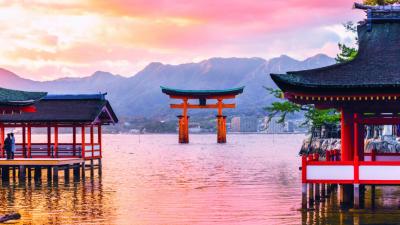
This post is about Hiroshima Prefecture. Most of my Japan private tour clients visit Hiroshima; most of them go there as a day trip from Kyoto, usually including a stop at Himeji Castle enroute.
Hiroshima was destroyed by the world's first atomic bomb was on August 6, 1945. The bomb basically leveled everything within 2 km of where the bomb hit. After World War II, the city was rebuilt at great expense and the Hiroshima Peace Museum came into existence as shrine to the horrors of atomic and nuclear bombs.
I bicycled from Osaka to Hiroshima with a Scandinavian bike for peace group in the late 1980s. When we reached the city of Hiroshima we stayed in facilities where the aging hibakusha victims of the bomb lived. It was horrific to see the "melted" faces and bodies of the hibakusha. Today, there are few survivors left but the Peace Park continues to attract hundreds of thousands of foreigners every year. Most of my American clients go to Hiroshima to pay their respects for what the US did to the city and the Japanese people.
For clients that sleep in Hiroshima City, the Saijo sake district is also well worth visiting. It is one of Japan’s largest sake production areas.
The second (or first, depending on the individual) major attraction of Hiroshima Prefecture is Miyajima Island and its famous seaside shrine, Itsukushima Shrine, which is covered below. Remember, to see this shrine in all its glory you must be there during high tide. If you are there at low tide, the seaside part of the shrine is a huge exposed mud flat.
Hiroshima Prefecture is also famous across Japan for its super fluffy okonomiyaki savory pancakes. Learn more!
The rest of this post covers:
Japan private travel content by Your Japan Private Tours' (established in 1990) founder Japan travel expert Ian Martin Ropke. I have been planning, designing, and making custom Japan private tours on all five Japanese islands since the early 1990s. Your Japan Private Tours specializes in bespoke travel for private clients (I do not work with agents) including exclusive excursions, personalized experiences, and unique adventures. I am 100% client-centric and total individual attention. Consider my Japan travel services for your next trip. And thank you for reading my content. Learn more!
Miyajima Island and its famous seaside shrine
The island of Miyajima (Itsukushima Island) is just west of Hiroshima City and can be reached via two routes: by high-speed ferry, or by JR train and a short ferry ride. The island's Itsukushima Shrine is famous for its huge orange torii shrine gate standing in the sea in front of the shrine's main buildings (also built over the water), with Mount Misen in the background. It should be noted that the shrine gate is only standing in the sea during high tide (i.e., at least 3 hours after or before low tide; otherwise, the shrine gate is standing on a mud flat!). Under perfect conditions the seaside shrine is considered one of the three finest views in Japan.
Miyajima Island is usually a day trip but if you have the time I would highly recommend that you sleep one night there. After the tourists vanish in the late afternoon the entire historical scene feels as if it was built for you! And for foodies, please note that Miyajima is famous for its oyster cuisine. Miyajima also has a fairly large wild deer population that are used to people (but you can't feed them!).
Itsukushima Shrine: Itsukushima Shrine is large and consists of several buildings that linked by boardwalks built over the sea. Mount Misen, behind the shrine, has been a site of worship since the 6th century. The shrine itself was founded in 1168 by Taira no Kiyomori, who was the head of one the most powerful warrior clans at the end of the Heian period (794-1185). In a way, he was one of Japan's first samurai. The Taira clan had its main base in the imperial capital of Kyoto but also worked for the imperial court to police and battle pirates in the Seto Inland Sea. Itsukushima Shrine was built as the Taira clan shrine. After dark, the shrine buildings and the torii gate in the sea are lit up until 23:00 but can only be viewed from a distance (including from tour boats).
Ancient spiritual Mount Misen: Mount Misen stands directly behind Itsukushima Shrine and is the highest peak on the island. From the top on clear days, visitors can see all the way across the Seto Inland Sea to Hiroshima City! For the fit, it is easy to climb the mountain (500 meters above sea level) via one of three walking courses (allow for about 2 hours to reach the summit). For those who don't want to walk, the peak can be reached (almost) via a ropeway, which closes at 16:30. The top of the mountain has a number of Buddhist structures, which are the upper part of Daisho-in Temple at the base of the mountain. A flame at the temple's upper Reikado (Hall of the Spiritual Flame) has been burning since the 8th century and was used to light the Flame of Peace in Hiroshima's Peace Park.
Other high-value destinations in Hiroshima Prefecture
Charming Onomichi port town: Onomichi is a famous old port town in the eastern part of Hiroshima Prefecture that includes a few serene islands in the Seto Inland Sea. The mainland part of the town is hilly and home to many ancient Buddhist temples that can be reached via charming narrow lanes. For hiking and biking fans, Onomichi is the southern end of the Shimanami Kaido route, which links many islands in the Seto Inland Sea to Shikoku Island. If you are interested in Onomichi, I would highly recommend spending one or two nights there.
Rustic Tomonoura port & fishing town: Old-fashioned or retro Tomonoura port town lies east of Onomichi facing a bay on the Seto Inland Sea. The town is part of the Setonaikai National Park. When sailing ships were the only large boats on the Seto Inland Sea, Tomonoura prospered at a stopping off point to catch the best tides. Before the modern steel-hulled, engine-driven ships of the early 20th century, many ships and sailors stopped in Tomonoura. The town became prosperous from its sale of medicinal homeishu shochu liquor made with 16 different herbs, which is the town’s most popular souvenir (even now). Today, tourists come from all over to experience the old alleys of central historic Tomonoura lined with rustic old wooden buildings. In the last few decades, Tomonoura was used as a filming location for the "The Wolverine" film (starring Hugh Jackman). The setting for Studio Ghibli's "Ponyo on the Cliff" animation film was based on Tomonoura’s old town. The town's symbol is the Joyato Lighthouse dating from the Edo period (1603-1868). Tomonoura's splendid, late 17th-century Ota Residence was built by a prominent homeishu liquor brewing family and is now open to the public. Local Fukuzenji Temple is famous for its views of Bentenjima island and Sensuijima island. The temple is home to a statue of the Christian Virgin Mary, which was used by Japan's secret Christians in the Edo period.
- Indexed full list of all my blog posts | articles.
- Indexed full list of all my Japanese culture essays.
Japan private travel content by Your Japan Private Tours' (established in 1990) founder Japan travel expert Ian Martin Ropke. I have been planning, designing, and making custom Japan private tours on all five Japanese islands since the early 1990s. Your Japan Private Tours specializes in bespoke travel for private clients (I do not work with agents) including exclusive excursions, personalized experiences, and unique adventures. I am 100% client-centric and total individual attention. Consider my Japan travel services for your next trip. And thank you for reading my content. Learn more!