Japan private tour news about lost Chinese tourism revenue & and the attractions of Shimane Prefecture
Before I get into today's blog post about travel highlights for Shimane Prefecture, I would like to comment on Japan's China tourism crisis.
In today's world it is very important to consider the effects of national leaders' comments before they become news. Japan's current prime minister, Sanae Takaichi, who has only been prime minister since Oct 21, 2025, learned this the hard way. And her remarks could cost Japan nearly USD 15 billion a year in lost tourist revenue!
Takaichi-san made the mistake of stating Japan would use military force if China invaded the island nation of Taiwan. Within days, the Chinese government and Chinese media urged Chinese travelers to avoid Japan as a travel destination. And suddenly Japanese travel-related stocks started plummeting. Chinese tourists made up nearly 30 percent of Japan's inbound tourists in 2019 (i.e., before Covid). In 2025, Chinese tourists accounted for 20 percent of Japan's international tourists.
By annoying Beijing, Japan stands to lose nearly 20% of its international tourism income or roughly USD 15 billion a year in lost revenue!
According to the World Travel & Tourism Council, tourism accounts for about 7% of Japan's overall gross domestic product (USD 4 trillion dollars in 2024!). Now 7% doesn't sound like a lot but it is and it's just the beginning. The Japanese government hopes to raise this figure to 12% of GDP in the next ten to fifteen years! In 2025, Japan will likely receive 40 million international tourists (in 2019 it was 33 million).
The top ten countries for international tourism arrivals in 2024, pre-Trump were: France (102 million), Spain (94 million), US (72 million), Turkey (60 million), Italy (58 million), Mexico (45 million), UK (42 million), Germany (38 million), Japan (37 million), and Greece (36 million).
The Japanese government has been focused on reaching 60 million foreign visitors by 2030 since 2016 as part of its "Tourism Vision to Support the Future of Japan" plan. And at 60 million international visitors over 10-12% of Japan's overall gross domestic product will come from travel!
Naturally, Japan's main tourist business and tourism stocks are hoping the China crisis is temporary. But to appease Beijing, Japan's prime minister will have to apologize for her remarks. But that will not be easy as Japan is increasingly militaristic and considers Taiwan to be a major ally. Time will tell . . .
The rest of this post covers:
- The charms of Matsue City and its surroundings
- The impressive world of Izumo Grand Shrine
- The charms of Tsuwano Town in western Shimane
Japan private travel content by Your Japan Private Tours' (established in 1990) founder Japan travel expert Ian Martin Ropke. I have been planning, designing, and making custom Japan private tours on all five Japanese islands since the early 1990s. Your Japan Private Tours specializes in bespoke travel for private clients (I do not work with agents) including exclusive excursions, personalized experiences, and unique adventures. I am 100% client-centric and total individual attention. Consider my Japan travel services for your next trip. And thank you for reading my content. Learn more!
The charms of Matsue City and its surroundings
Matsue City (population 197,000) is the capital of Shimane Prefecture. The city is also called Japan's water city as it located between two large lakes and near the Sea of Japan.
High-value travel spots in & around Matsue City:
The amazing Adachi Museum of Art and garden: The Adachi Museum of Art, founded by Adachi Zenko in 1970, combines fine Japanese art with exquisite Japanese gardens. It is famous for its award-winning, view-only garden, which has been named the best in Japan since 2003 and changes with the seasons. The museum has a collection of roughly 1,300 20th-century Japanese paintings that are rotated seasonally, a permanent exhibition of nihonga paintings by Yokoyama Taikan (1868-1958), and a ceramics exhibit.
The wonders of Yushien Garden: The fabulous Yushuien Garden sits on the almost empty island of Daikonshima in the center of brackish Lake Nakaumi just outside of Matsue City. This private garden (built in 1975) covers 40,000 square meters and is home to a large central pond, waterfalls, streams, stone lanterns, a rock garden, and all kinds of seasonal flowers. The garden is especially famous for its 250 different kinds of peony flowers. Normally, peonies are a spring phenomenon but at the Yushien Garden they can be seen in flower year round (indoors and outdoors). However, the garden's annual Peony Festival, held between late April and late May, is the best time of year to see peony flowers in all their glory. The garden also cultivates Korean ginseng, which can be enjoyed and purchased as tea and edibles at the garden shop and cafe. The garden is also well known for its LED light up shows throughout the year (winter is the best season for the light up show!). The lake and island garden are about 10 km east of central Matsue City.
Perfectly preserved Matsue Castle: Matsue Castle is one of Japan's twelve surviving original castles. This means that the castle's original main tower has survived intact. Most Japanese castle towers or keeps were destroyed by fire, earthquakes or the anti-feudal madness of the early Meiji period (1868-1912). Construction of Matsue Castle was completed in 1611. It sits atop a hill that is surrounded by a wide moat and thick walls. After touring the castle grounds on foot many visitors take a river boat cruise around the castle moat and the narrow canals of the Horikawa River.
The home of writer Lafacadio Hearn: Lafcadio Hearn (1850-1904) was an extremely influential Western author who introduced Japanese culture to the West. He was half Greek and half Irish. His writings offered unprecedented insight into Japanese culture, especially his collections of legends and ghost stories, such as Kwaidan: Stories and Studies of Strange Things. I have read most of his books and never cease to tire of them; they are so detailed and delightful at the same time. Hearn emigrated to Japan in 1890. He was an English teacher and eventually became a Japanese citizen with the name Koizumi Yakumo. His former residence in the samurai district of Matsue, which I have visited on two occasions, is simply amazing and well worth the effort!
The impressive world of Izumo Grand Shrine
The city of Izumo lies on the Sanin Coast of the Sea of Japan in Shimane Prefecture, and is best known for Izumo Grand Shrine, the second most important Shinto shrine in Japan after the Ise Shrines in Mie Prefecture (south of Nagoya). Izumo (or nearby Matsue, see below) is a fantastic place to explore a key part of Japan's ancient history and mythology.
Izumo Grand Shrine or Izumo Taisha is considered to be one of Japan's oldest shrines and was already well established when Japan's earliest historical chronicles were "published" in the early 8th century.
In pre-historic Japan, the Izumo region was ruled by a powerful clan and played a key role in Japan's creation mythology. The primary deity at Izumo Taisha is Okuninushi no Okami, who created Japan and was also the spiritual ruling spirit of the Izumo region. Later, this male deity was also associated with good relationships and marriage. And for this reason, visitors to the shrine do not clap twice to call the gods but four times: twice for themselves and twice for their partners (or partners to be).
Izumo Grand Shrine is also the location of Japan's annual Shinto god and goddess gathering! This special conclave of Shinto Gods occurs annually between the 10th and 17th day of the 10th lunar month (which is usually November).
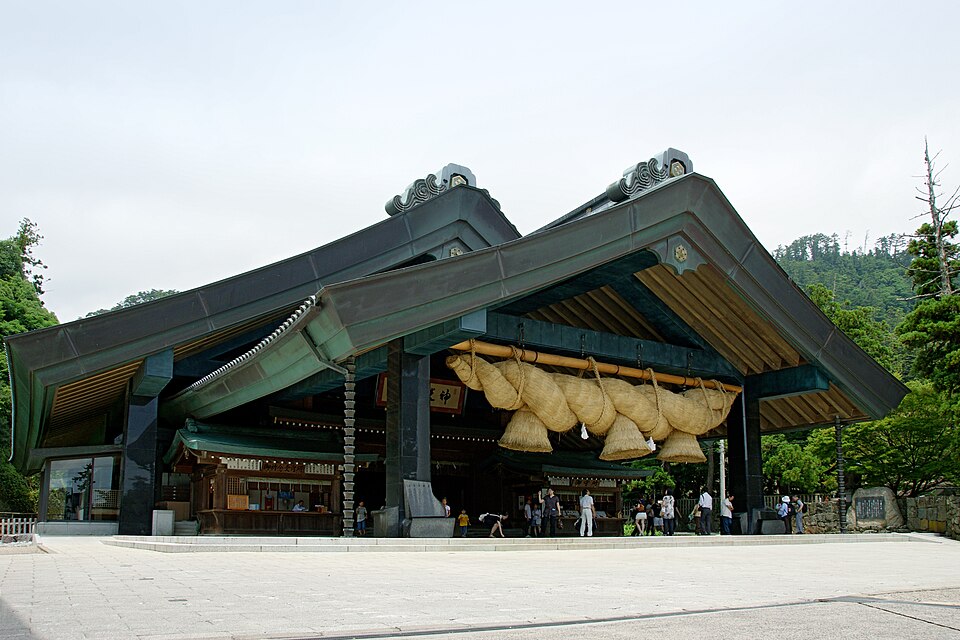
The shrine's main approach begins at a massive wooden torii gate, just past a lively shopping street. The broad entrance gravel walkway continues north and then splits into three separate paths: left and right are for humans, while the central path is reserved for visiting Shinto deities. Finally, visitors will come to a large bronze torii gate and shrine's main grounds. This is where Izumo Taisha's famous sacred straw rope (shimenawa) hangs horizontally beneath the eves of a massive wooden structure. Shimenawa indicates the presence of a deity and separates the divine or sacred world from the mortal, secular or profane realm.
Until 1744, the main structures of Izumo Taisha were also rebuilt as they still are every 20 years at Ise. Today, Izumo Taisha's main buildings are only rebuilt every 60 years, a process that takes about five years. The last rebuilding was completed in 2013.
Just east of the shrine grounds is the Shimane Museum of Ancient Izumo, which is the perfect place to learn more about the shrine and the Izumo region in ancient times.
The charms of Tsuwano Town in western Shimane
Tsuwano Town (population less than 7,000), at the western edge of Shimane Prefecture, is surrounded by hills and is famous for its relaxed atmosphere. The heart of the town is a step back in time, with streets lined by old samurai mansions featuring white earthen walls, dark red roof tiles, and traditional wooden grated windows. A vibrant waterway runs along the main street, its lively carp adding splashes of color to the picturesque scene. This historic atmosphere is complemented by the spiritual significance of the Taikodani Inari Shrine, recognized as one of Japan's five greatest Inari shrines.
Taikodani Inari Shrine: Taikodani Inari Shrine, built in the mid-18th century, is one of Japan's five major Inari shrines and was originally constructed to protect Tsuwano Castle from evil spirits. Today, it is a popular destination for people seeking good fortune, prosperity, and a successful harvest. The shrine is reached via a scenic 15-minute climb up a mountainside, following a path lined with thousands of vermillion torii gates.
Tsuwano's old samurai merchant area: Tsuwano, along with a few other places in Japan, is also referred to as a "small Kyoto." This is because the historical core of Tsuwano (like Kyoto's historical core; home to countless machiya merchant residences) is well preserved to the extent that it looks like it did in the Edo period (1600-1868). Tsuwano's Tonomachi district, a former samurai district, is stunning for its well-preserved high earthen walls, old buildings and a carp filled canal. Next to the Tonomachi district is a small merchant area that includes sake shops and a couple of museums.
Maria Seido chapel honors persecuted Japanese Christians: Tsuwano's Otome Toge Maria Chapel was constructed in 1951 to honor the memory of the Japanese Christians who were relocated to and persecuted in Tsuwano in the early years of the Meiji period (1868-1912). This small, timeworn chapel, in the woods west of Tsuwano Station, marks a unique period of Japanese history. Christianity was strictly prohibited in Japan for nearly the entire Edo period (1600-1867). However, some Japanese Christians continued to practice their forbidden faith in secret (like the Jews of Spain and the early Protestants of the British Isles). When the Edo shogunate fell, many Japanese Christians felt they could openly proclaim their religion, but they were wrong. Most of these Christians were from the area of Nagasaki where the Dutch had their harbor trading post on Dejima Island. Upon confessing their faith, they were taken away to “conversion camps” all over Japan to be converted into Buddhists through persuasion, and torture in some instances. The Maria Seido chapel marks this dark side of Japanese religious history.
Tsuwano Castle Ruins: The Tsuwano Castle Ruins, mostly stone walls, are on a high mountain ridge above the old town of Tsuwano. The castle was originally built at the end of the 12th century as a wooden fortress. In the early 16th century, the castle was rebuilt in the feudal style with high stone walls. The castle was hit by lightning in 1686 and burned to the ground and never rebuilt. However, the views from the ruins are amazing at dawn and at sunset and on full moon nights.
- Indexed full list of all my blog posts | articles.
- Indexed full list of all my Japanese culture essays.
Japan private travel content by Your Japan Private Tours' (established in 1990) founder Japan travel expert Ian Martin Ropke. I have been planning, designing, and making custom Japan private tours on all five Japanese islands since the early 1990s. Your Japan Private Tours specializes in bespoke travel for private clients (I do not work with agents) including exclusive excursions, personalized experiences, and unique adventures. I am 100% client-centric and total individual attention. Consider my Japan travel services for your next trip. And thank you for reading my content. Learn more!