Japan private tour insights about unagi eels and Fukuoka City
Eels are ancient creatures and believe it or not an extremely valuable food resource that is declining all over the world. In particular, freshwater eels are super important for the global sushi industry. Some freshwater eels species have declined by more than 90% since the 1980s when the global sushi industry got started. Until the 1980s sushi was something unique to Japan but that all changed with globalization and the spread of all cuisine types to everywhere.
Baby anguilla eels or elvers are valuable as seed stock used by Asian aquaculture companies to create adult eels. In Japan, freshwater eel is called unagi and unagi is a cuisine type in itself as well as a sushi ingredient.
Freshwater eels have greatly decreased in numbers worldwide because of dams, turbines used in hydro power stations, pollution, and climate change. And don't forget illegal poaching and over fishing! Baby eels fetch over USD 2,500 per kilogram! Some readers may have seen the Netflix series "Bodkin," which features the illegal breeding of eels for big profits.
The recent Uzbekistan Convention on International Trade in Endangered Species of Wild Fauna and Flora (CITES) proposed sweeping restrictions to protect eels of the anguilla genus. Unfortunately, these protective regulations did not pass because China, Japan and the U.S. opposed them. Eels are a valuable food commodity in all three of these countries.
European eels have been protected since 2009 by CITES regulations. So far, American, Japanese and Chinese eels have not become protected species.
Fishing companies and organizations are not the only entities resisting the expansion of eel protections. The governments of Japan, China, South Korea, Taiwan and the U.S. have opposed CITES repeatedly when it comes to freshwater eel protections. And all of these countries profit immensely from eels as a commodity for the food industry. Hopefully, this will change in the future but for now unagi is still on the menu!
In Japan there are actually two kinds of edible eels: freshwater unagi eel and saltwater anago eel. Unagi is generally grilled and served in big pieces or as chunks on rice bowls. Unagi is also used for nigiri sushi but it's expensive so only on the menu at high-end sushi restaurants. Anago are primarily used as a tempura and sushi ingredient. Unagi is characterized as rich, fatty and sweet. Anago is lighter, milder in taste and more delicate (and less expensive!).
The rest of this post covers:
Japan private travel content by Your Japan Private Tours' (established in 1990) founder Japan travel expert Ian Martin Ropke. I have been planning, designing, and making custom Japan private tours on all five Japanese islands since the early 1990s. Your Japan Private Tours specializes in bespoke travel for private clients (I do not work with agents) including exclusive excursions, personalized experiences, and unique adventures. I am 100% client-centric and total individual attention. Consider my Japan travel services for your next trip. And thank you for reading my content. Learn more!
Modern, Asian Fukuoka City, the capital of Fukuoka Prefecture
Fukuoka City is by far the biggest city on the island of Kyushu. The city is located close to the Asia mainland and has been a key Japanese trade center for centuries. In 1889, the port city of Hakata became part of Fukuoka City, which was formerly an important castle town.
Fukuoka is different from other big Japanese cities. It's less expensive and known for a more relaxed and friendly atmosphere that is open to foreigners more than anywhere else. The city is also known for its innovative spirit and as a key semiconductor center. Fukuoka City is also close to incredible nature that includes coastal areas and mountains. And onsen hot spring bathing is easily accessible.
A few of Fukuoka City's tourist attractions:
Yatai food stall cuisine: Fukuoka's open air yatai food stands are famous in Japan. These small restaurants seat less than 10 people and provide simple, inexpensive foods combined with great social interactions. The highest concentration of yatai food stalls can be found at the south end of central Nakasu Island. Typical yatai dishes include yakitori grilled chicken skewers, oden hot pot cuisine (especially in winter), and distinctive Hakata ramen.
Shofukuji, Japan's oldest Zen temple: Shofukuji Temple is considered to be Japan's oldest Zen temple. The temple dates back to 1195 and was founded by the priest Eisai, who introduced Rinzai Zen Buddhism to Japan (the other form of Zen Buddhism is call Soto Zen, which is more austere). The grounds of Shofukuji are home to many wooden buildings, impressive temple gates and ancient Buddhist sculptures. The power of Zen became the power of the samurai class in the late 12th century when Kamakura, near Tokyo, became the first shogun military capital of Japan.
Fukuoka's Canal City shopping & entertainment complex: Canal City Hakata is one of Japan's biggest shopping and entertainment complexes and is home to more than 250 businesses ranging from shops and restaurants to cinemas and a theatre. The complex even has its own canal! On the 5th floor visitors can enjoy the wonders of ramen at the Ramen Stadium.
Fukuoka Castle ruins: The ruins of Fukuoka Castle, which was the largest feudal castle in Kyushu, are located in Maizuru Park in the center of the city. Originally, the castle was known as Maizuru Castle. The Kuroda samurai clan, who were loyal supporters of the Edo-Tokyo shoguns, ruled from Maizuru Castle for nearly 200 years. Today, the park and the castle ruins are a popular relaxation zone. In spring, the entire park becomes a pink cherry blossom wonderland.
Uminonakamichi Park: Uminonakamichi Seaside Park is a large park (almost 4 km in length) located on a peninsula across the bay from downtown Fukuoka City. The park was built for family relaxation and includes gardens, playgrounds, sports fields, and large open areas ideal for family picnics. and lawns perfect for picnicking. The park is very popular for flower viewing and home to millions of flowers of all kinds. Adjacent Marine World Uminonakamichi is an outstanding aquarium focused on the marine life of Kyushu Island.
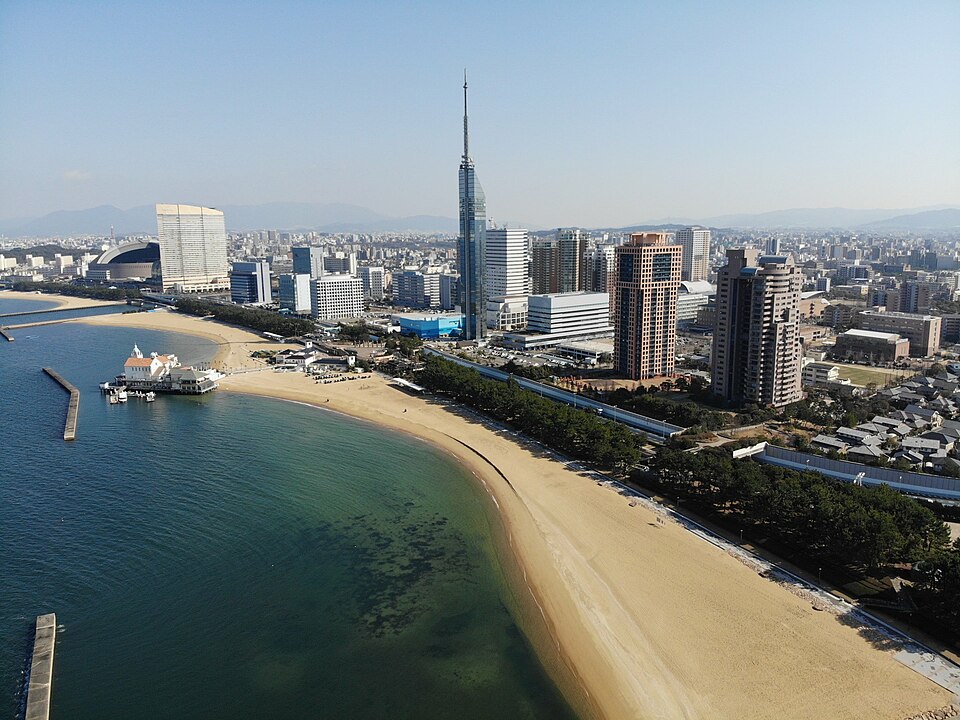
Momochi seaside park: Seaside Momochi on the Fukuoka waterfront was built on reclaimed land facing Hakata Bay. The site was first used for the 1989 Asia Pacific Expo. The original design focused on wide, shaded streets, modern buildings, beaches and museums. Today, the park is also home to a wide range of shopping and dining experiences. The park's long artificial beach is popular for swimming and sporting activities. Fukuoka Paypay Dome, located in the park, was Japan’s first retractable roofed dome and multi-use arena.
- Indexed full list of all my blog posts | articles.
- Indexed full list of all my Japanese culture essays.
Japan private travel content by Your Japan Private Tours' (established in 1990) founder Japan travel expert Ian Martin Ropke. I have been planning, designing, and making custom Japan private tours on all five Japanese islands since the early 1990s. Your Japan Private Tours specializes in bespoke travel for private clients (I do not work with agents) including exclusive excursions, personalized experiences, and unique adventures. I am 100% client-centric and total individual attention. Consider my Japan travel services for your next trip. And thank you for reading my content. Learn more!