Japan private tour insights: trending Jimbocho in Tokyo & Fukuoka Prefecture Part 2
Before I get into Fukuoka Prefecture Part 2, I'd like to comment on the world's coolest neighborhood of 2025. And you have probably never heard of it!
Jimbocho, a short distance northwest of Tokyo Station, has long been a favorite hangout area for Japan's intellectuals, book hounds and university students. And in 2025, it was voted the coolest neighborhood in the world by the experts at TimeOut, the media and hospitality company headquartered in London, UK.
Jimbocho has 130 second-hand bookstores, and most of them are in buildings that also have old-world coffee shops and simple restaurants. And students from seven nearby universities have changed the face of Jimbocho over the last decade. The area's back streets, mostly narrow, are being taken over by new kinds of music clubs, cafés, indie booksellers and more!
If you are young or interested in the survival of book culture and culture in general be sure to add Jimbocho to your list on your next Japan trip. Consider these places if you go: 1. Rare and vintage books at Isseido Booksellers or Kitazawa Bookstore. 2. An amazing collection of art books and indie magazines at Stacks Bookstore. 3. A coffee break at 70-year-old Sabor, or Walkabout Coffee (known for its Magic, a Melbourne coffee invention that includes a double-shot ristretto and silky steamed milk). 4. And in the evenings consider world-class curry at Curry Bondy or Sangatsu no Mizu. Or drinks at Cocktail Works Jinbocho or Yon (which is an art gallery, bar and music listening space).
The rest of this post covers:
Japan private travel content by Your Japan Private Tours' (established in 1990) founder Japan travel expert Ian Martin Ropke. I have been planning, designing, and making custom Japan private tours on all five Japanese islands since the early 1990s. Your Japan Private Tours specializes in bespoke travel for private clients (I do not work with agents) including exclusive excursions, personalized experiences, and unique adventures. I am 100% client-centric and total individual attention. Consider my Japan travel services for your next trip. And thank you for reading my content. Learn more!
Kyushu's ancient capital of Dazaifu
Kyushu was where Japanese civilization really got started. The north end of the island "almost" touches the Asian mainland and was really the only geographical point where new ideas and trade could flow to from China and South Korea. The city of Dazaifu was established in the late 7th century as an administrative center for all of Kyushu and it served this purpose for more than 500 years (essentially until the end of the Heian period and the establishment of the first shogun-samurai military capital at Kamakura in 1185).
Dazaifu was established a short distance inland from Fukuoka City. Fukuoka's port (Hakata) was Japan's biggest international port and diplomatic center for relations with the Asian mainland. Today, this small ancient city continues to attract many day trippers from nearby Fukuoka City. Dazaifu is home to a number of outstanding historical heritage sites and the amazing Kyushu National Museum (2005).
Tenmangu Shrine: Dazaifu's Tenmangu Shrine, one of thousands across Japan, is dedicated to the spirit of the scholar and politician Sugawara Michizane. Michizane was so learned and wise that he became directly connected with the Shinto god of education. Unfortunately, he became a threat to the powerful Fujiwara clan that basically ran the Japanese capital of Heiankyo (Kyoto). To limit his power in the capital he was exiled to Dazaifu. And a few years later, in 903, he died in exile. Soon after, Japan endured a series of major natural disasters and people began to say that it was the revengeful ghost of Michizane causing the disasters. The emperor decreed that a Tenmangu Shrine be erected near Michizane's grave in Dazaifu and also in Kyoto (Kitano Tenmangu Shrine). And before long the disasters stopped and Tenmangu Shrines were built all over Japan. Today, nearly every student in Japan will visit a Tenmangu shrine annually to pray for examination good luck and to buy special good-luck talismans known as ema and omamori. The approach to Dazaifu Tenmangu Shrine is lined on both sides with all kinds of shops selling souvenirs, food and educational goods. And once inside the shrine precinct visitors will find a pond shaped like the Chinese character for heart (kokoro) and lots of plum trees (a February travel delight). Michizane loved plum trees more than any other flowering tree. I have been celebrating plum blossoms over the cherry blossoms pretty much from my arrival in Japan. I love the zig zagging branches, which are a staple in Japanese ink drawings. Ume plum trees are not native to Japan; they were imported from mainland China where they are known as the gentleman's tree.
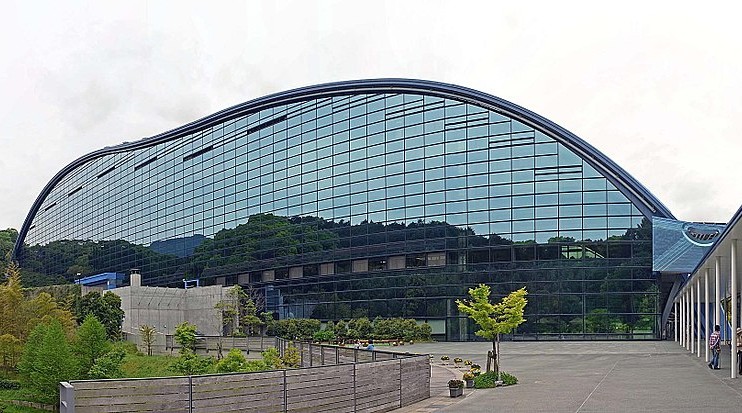
Kyushu National Museum: Dazaifu's Kyushu National Museum opened in 2005. There are only four national museums in Japan; the other three are in Tokyo, Kyoto and Nara. The Dazaifu national museum was built over 100 years after the other three were constructed at the end of the 19th century! The museum specializes in the theme of understanding Japanese culture from an Asian point of view. The museum building is massive and almost dwarfs the city itself. At first glance you would think it is a sports stadium. The museum is home to an impressive artifact collection, main exhibition halls and small movie theaters. And the facility has excellent English signage.
Kanzeonji Temple: Dazaifu's Kanzeonji Temple was established in 746. It is a Tendai esoteric sect Buddhist temple. The temple is considered to be the most important temple on the entire island of Kyushu. When Dazaifu's political influence began to wane at the end of the 12th century, Kanzeonji's fortunes also decline. Today, there are only a few buildings left in the complex. The temple's bell tower is home to the oldest bell in Japan! Kanzeonji's treasures range from Nara and Heian period Buddhist sculptures to incredible Buddhist art works.
The ancient international port & trade city of Kitakyushu
The city of Kitakyushu (North Kyushu) has served as a key land and sea traffic center since the beginning of Kyushu's history. It serves as the gateway to Honshu island and also as an important international trade center. In ancient times, the city was actually five different towns: Kokura, Moji, Yahata, Tobata, and Wakamatsu. Kitakyushu is one of Japan's earliest industrial cities. When Japan westernized in the early Meiji period (1868-1912) the Tokyo central government invested heavily in the Kitakyushu area. Today, the city is both super modern and very old-world at the same time. Here are Kitakyushu City's top travel attractions.
Moji Port: Moji Port is the closest city area to the western tip of Honshu island. The port served as an important international trade center from the end of the 19th century until the establishment of Shin or New Moji Port. The old port area has a wide range of buildings dating from the Meiji and Taisho (1912-1926) periods. Mojiko Station, near the waterfront area, is one of Japan's oldest classic train stations. Today, the old port buildings have been converted into cafes, shops, restaurants, galleries, and museums.
Kokura Castle: Kitakyushu's Kokura Castle was established in 1602. It burned down in 1866, and the current iron and concrete reconstruction is from 1959. The traditional architecture of the castle offers an attractive contrast to the adjacent modern shopping center. The castle's modern interior shows visitors the history of the area through excellent displays and an interactive experiential zone.
Tanga Market: Kitakyushu's covered Tanga Market is known as the "Kitchen of Kitakyushu." The market dates from the first years of the 20th century and is set along the Kantake River. Today, there are about 120 shops in the market, which specialize in seafood and other local food items. It's a great market to watch the locals shopping and for excellent restaurant experiences. It's a people place and cars can not even fit into the area's narrow, nostalgic lanes.
Kitakyushu Manga Museum: The Kitakyushu Manga Museum is focused mainly on famous manga artists from the Kitakyushu region. This includes an in-depth look at the work of Matsumoto Leiji, who is famous across Japan for his Space Battleship Yamato and Galaxy Express 999 manga comic book series. The museum is embedded in the Aru-Aru City mall, which is devoted manga and anime, games and idol music group souvenirs. The museum's "Manga Time Tunnel" showcases manga through time with some early comic books from just after World War II. Unfortunately, most of the museum signage is in Japanese but the manga art is well worth seeing if you are into manga.
Kawachi Wisteria Garden: The private Kawachi Wisteria Garden is located in the forested hills south of Kitakyushu. It is one of the most famous wisteria vine gardens in Japan and certainly best on Kyushu island. It is especially known for its two 100-meter-long wisteria tunnels featuring flowers that range from white to dark purple. Kawachi Wisteria Garden is very popular with both domestic and international visitors and advance reservations are required.
- Indexed full list of all my blog posts | articles.
- Indexed full list of all my Japanese culture essays.
Japan private travel content by Your Japan Private Tours' (established in 1990) founder Japan travel expert Ian Martin Ropke. I have been planning, designing, and making custom Japan private tours on all five Japanese islands since the early 1990s. Your Japan Private Tours specializes in bespoke travel for private clients (I do not work with agents) including exclusive excursions, personalized experiences, and unique adventures. I am 100% client-centric and total individual attention. Consider my Japan travel services for your next trip. And thank you for reading my content. Learn more!