Japan private tour travel tips for Nagasaki Prefecture Part 1
Nagasaki Prefecture is unique in Japan because of its early contact with Chinese and Western traders (and Christianity) and also because the prefecture's capital, Nagasaki City, was hit by the second atomic bomb dropped by the US in 1945. Luckily, the Nagasaki bomb was not as devastating as the Hiroshima bomb because it was not a direct hit, and much of historical Nagasaki survived the bomb.
The rest of this post covers:
Japan private travel content by Your Japan Private Tours' (established in 1990) founder Japan travel expert Ian Martin Ropke. I have been planning, designing, and making custom Japan private tours on all five Japanese islands since the early 1990s. Your Japan Private Tours specializes in bespoke travel for private clients (I do not work with agents) including exclusive excursions, personalized experiences, and unique adventures. I am 100% client-centric and total individual attention. Consider my Japan travel services for your next trip. And thank you for reading my content. Learn more!
The cultures and charms of Nagasaki City
Nagasaki City is a key port city on the island of Kyushu and also the administrative capital of Nagasaki Prefecture. The history of the city and its geographical location makes it one of the most interesting cities in all of Japan. And it is a city that is entirely free of the overtourism issues that plague Kyoto, Nara, Kanazawa, Kamakura, and Mount Fuji.
Nagasaki City, like Kitakyushu City and Fukuoka City, is not far from the Asian mainland. And for this reason, the city was a key foreign trade port for centuries with mainland China, the Ryukyu kingdom (now Okinawa Prefecture) and Korea. And during the time that Japan isolated itself from the outside world for about 200 years during the Edo period (1600-1868) Nagasaki City was one of the few ports that allowed foreign ships to dock offshore from the city. and was the most important of only a very few ports open to restricted numbers of foreign traders during Japan's period of isolation. In more recent history, Nagasaki became the second city after Hiroshima to be destroyed by an atomic bomb in 1945.
High-value attractions in Nagasaki:
Nagasaki Peace Park: The Nagasaki Peace Park, like the Hiroshima Peace Park, offers visitors a chance to pay their respects to the victims of the atomic bombing of World War II. The Nagasaki bombing occurred on August 9, 1945, and wiped out a big part of the city and tens of thousands of lives. The current Nagasaki Peace Park complex comprises two large parks and memorial museum. The Hypocenter Park features a black monolith marking the epicenter of the explosion. Another area of the park shows visitors what lies beneath the ground ranging from bricks and glass fragments of traditional Japanese roof tiles. The Nagasaki Atomic Bomb Museum is built into a hill in the park. The other park in the complex, Memorial Park, is north of Hypocenter Park, and is home to the famous Nagasaki Peace Statue and numerous other memorials given to the city by governments and organization across the planet including monuments that honor the Chinese and Korean victims of the bombing.
Glover Garden: Nagasaki's open-air museum, Glover Garden, on a hillside just off the old port, is home to a number of historical foreign residences when the city was home to countless merchants and traders in the late 19th century. Glover House, the oldest Western-style wooden building in Japan, was the home of Thomas Glover (1838-1911), a Scottish merchant who moved to Nagasaki when it opened to the outside world in 1859. Glover also distinguished himself by promoting early industrialization in Japan and siding with the revolutionaries of Western Japan who overthrew the Tokugawa shoguns in 1868. This history of Japan was used by the genius Japanese film director Akira Kurosawa and was adapted by George Lucas as the basis for the Star Wars movies! The Glover Garden complex is also home to a few other opulent Western-style buildings that were relocated from other parts of the city. The garden's hillside location offers excellent views over the city and its harbor area (where cruise ships now dock).
Sofukuji Temple: Sofukuji Temple is located a bit north of the Glover Garden complex. The temple belongs to the Chinese Obaku Zen sect, Japan's smallest Zen sect after the Rinzai and Soto sects. The temple was constructed in 1629 in the Chinese style for Zen monks who had to flee from China and later used by Nagasaki's numerous Chinese residents (mostly traders) for spiritual purposes. The temple buildings are painted a distinctive bright red color. The temple's Buddha Hall was made in China and then dismantled and sent to Nagasaki and rebuilt and it one of the oldest extant buildings in the city.
Dejima Dutch island: The man-made island of Dejima sits just off the coast of Nagasaki. It was built initially to keep Portuguese traders and missionaries away from the mainland Japanese residents. The threat of a foreign religion and foreigners in general was a big thing in Japan until 1868 when the country suddenly went all in on Western ideas (scientific and philosophical), western clothing, and western foods (meat, meat, meat!). However, Christian ideas were never welcome, and hundreds of missionaries were cruelly tortured and killed under the Tokugawa shogunate (1600-1868). Eventually, the Portuguese were all expelled from Dejima island and were "replaced" with Dutch traders (Protestants!) who formerly were based at nearby Hirado. During Japan's 200 years of total isolation from the outside world in the Edo period (the period featured in the James Clavell's famous "Shogun" novel and film adaptation) the Dutch and the Chinese were the only foreigners allowed in Japan (or the edge of Japan, as it were). This period of history is brilliantly and hauntingly covered in David Mitchell's novel "The Thousand Autumns of Jacob de Zoet" (2010). Present-day Dejima is now attached to the mainland due to extensive land reclamation in the 20th century. However, a number of old Dejima buildings remain including homes, gates, and warehouses. This is a site well worth visiting to understand Japan's isolation from the outside world in the Edo period. There is a plan to carve canals around the land of the original Dejima island land to turn it into an island again!
Nagasaki Museum of History and Culture: The Nagasaki Museum of History and Culture is known as superbly designed and curated modern museum about Nagasaki's international trading port history. The museum's extensive permanent exhibition covers two entire floors of the museum. During Japan's isolation period in the Edo period Nagasaki was one of only 2-3 ports that permitted trade interactions with foreign traders (and their foreign ideas). In a way, Nagasaki was always the city that defined the realities of interacting with Western barbarians. Yokohama and Kobe only took over this role in the Meiji period (1868-1912). The museum has three separate areas that brilliantly document Japan's relationship with China, Korea and the Netherlands. And don't forget that this relationship was administered by the Edo-Tokyo Tokugawa shogunate via a magistrate stationed in Nagasaki. The museum features an entire wing that recreates the former Magistrate's Office including reception rooms and an interrogation and courtroom for dealing with smugglers and other criminals of that time. The museum also has exhibits of Nagasaki's craft traditions, Japanese and Westernized, ranging from lacquerware to porcelains. Another section looks at the influences of Western scientific ideas that arrived via Nagasaki (chemistry, medicine, physics, and technology).
Chinese Zen Kofukuji Temple: Kofukuji Temple is the first place the Chinese Obaku school of Zen Buddhism (see above) gained a foothold in Japan. The temple was established in 1620 by the Chinese monk Ingen Ryuki, who fled to Japan during the Manchu conquest of China. The Obaku school of Zen had a strong influence on the Japanese Rinzai Zen sect. At the same time, Nagasaki was an increasingly important trade center for Chinese merchants. The temple is distinctly Chinese in style and thus very different from almost all other Buddhist temples in Japan. A famous, big glass lantern, imported from China, hangs in the temple's main hall and attracts many admirers even today.
Confucian Shrine: The Nagasaki Confucius Shrine is rare example of a shrine that is not based on the Shinto religion in Japan. Instead, it is dedicated to the teachings of the Chinese philosopher Confucius (551-479 BC). It was constructed in 1893 by Nagasaki's extensive Chinese community. The shrine is very colorful and distinctly Chinese and features a garden pond and classic bridge over the pond. In the courtyard are life-size statues of China's 72 sages where the disciples of Confucius.
Dutch Slope: Nagasaki's Dutch Slope is a sloping stone-paved road that was home to the most prominent Western traders who were permitted to live on the mainland from 1859 onwards. For nearly 200 years the only Westerners on the edge of Japan (Dejima island, see above) were the Dutch, so Westerners were basically defined as Dutch people! The 1859 opening of key ports in Japan, eventually including Kobe and Yokohama, attracted Americans and British traders in droves. The former residences on the Dutch Slope were used by these traders. The Higashi Yamate 13 residence was the home of an affluent European family and is well preserved and open to the public.
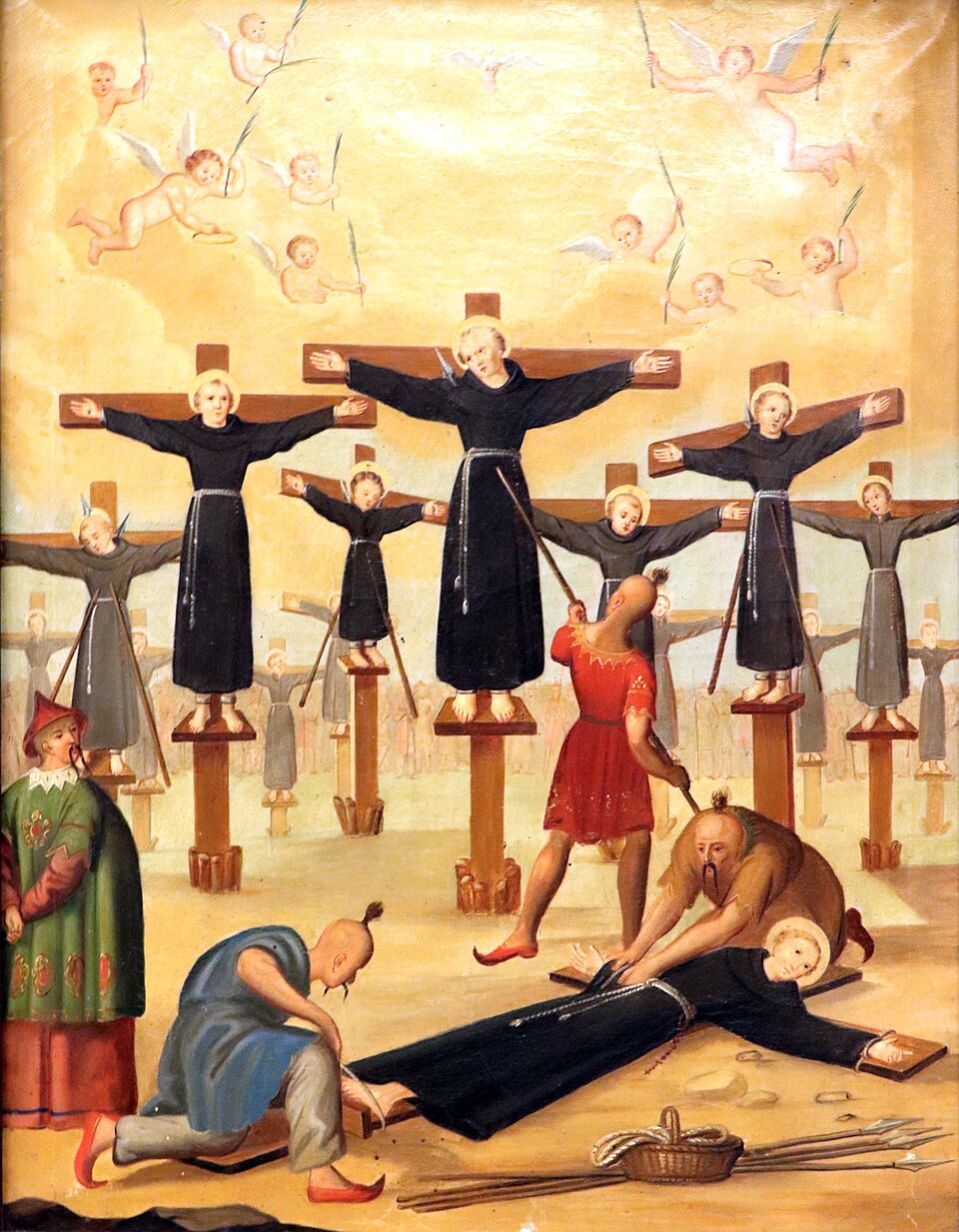
Twenty Six Martyrs Monument: Nagasaki's Twenty Six Martyrs Monument and museum are devoted to the twenty-six Christians executed at this location in 1597. The executions included Portuguese missionaries and Japanese converts. Japan was largely ruled by Toyotomi Hideyoshi from his massive castle at Osaka (he invaded Korea twice in the late 16th century). The museum at the rear of the monument is all about those martyred souls and the dangerous history of Christianity in Japan.
Chinatown: Nagasaki Shinchi Chinatown is by far the oldest Chinatown in Japan. The other two younger and much larger Chinatowns that come to mind are those in Yokohama and Kobe. The Nagasaki Chinatown today is mostly about eating foods that are unique to Nagasaki culture (Chanpon and Sara Udon noodles) and shops devoted to Chinese medicines and other products. Nagasaki's original Chinatown was also a reclaimed island like Dejima (see above). Nagasaki's Chinese traders were initially given a bit more freedom than their Dutch counterparts but eventually they were also confined to a walled off district.
Gunkanjima: The tiny island (480 meters by 150 meters) of Gunkanjima is roughly 20 km from the port of Nagasaki. The island was a coal mine until 1974 and home to about 5,000 people and is still the record holder for maximum population density. To house all these people in such a small area the entire surface of the island was built up with ferroconcrete high rises. And this is how the island got its nickname: Battleship Island. The island's actual name is Hashima but most people call it Battleship Island or Gunkanjima. Coal was found on the island in 1810 and became a profitable energy source initially for the samurai lords of Saga, which is now a separate prefecture just east of Nagasaki Prefecture. Industrial level mining started at the end of the 19th century and soon after the entire island and its coal became the property of Mitsubishi Corporation, one of Japan's largest industrial conglomerates then and now. Over time, as coal production increased, the island was surrounded by high sea walls and more and more high residential and industrial buildings were constructed. Fifty percent of the island was for the processing of coal and the other half was for housing. But in the spring of 1974 the mine was shuttered and the island abandoned. In the decades after the mine's closing, the island's infrastructure was worn down and broken down by storms and high waves resulting in a somewhat haunted look. And as the wear on the island's infrastructure continued it was closed to public access and could only be viewed from offshore on sightseeing cruises. In 2009, as the island's tourism attractiveness increased, a new dock was built for sightseeing cruises, and three observation decks were constructed at the south end of the island. The weird atmosphere of the island was used as a setting for the 2012 007 film "Skyfall" starring Daniel Craig (and the film suggested the island was near Macau, which it is not). The boat ride to the island from Nagasaki port takes a bit less than an hour. For tourists who don't make it to Gunkanjima the Gunkanjima Digital Museum in Nagasaki City offers augmented reality and digital experiences of the island that are really well done.
- Indexed full list of all my blog posts | articles.
- Indexed full list of all my Japanese culture essays.
Japan private travel content by Your Japan Private Tours' (established in 1990) founder Japan travel expert Ian Martin Ropke. I have been planning, designing, and making custom Japan private tours on all five Japanese islands since the early 1990s. Your Japan Private Tours specializes in bespoke travel for private clients (I do not work with agents) including exclusive excursions, personalized experiences, and unique adventures. I am 100% client-centric and total individual attention. Consider my Japan travel services for your next trip. And thank you for reading my content. Learn more!