News about taka hawk attacks and Japanese coin and bill info
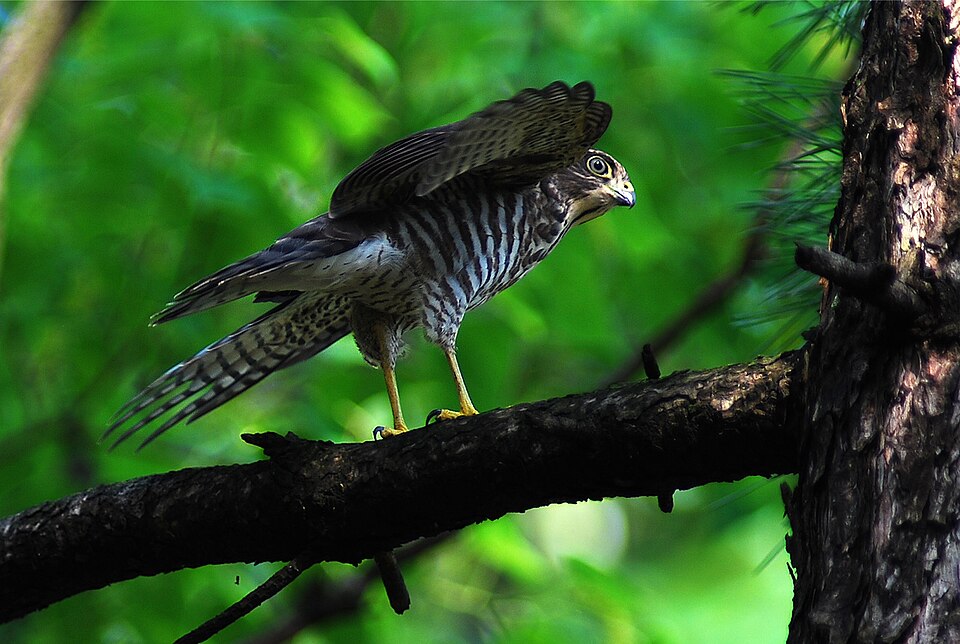
Japanese Sparrowhawks are usually something tourists see in Japan floating high overhead on thermals. Their slightly V-like tilted wing position and wide tails make them easy to identify. I'm a bird watcher since birth. I am always in awe when I see Japanese Sparrowhawks or taka soaring in the distance.
But recently in Kyoto, on three separate occasions, I have seen these large birds of prey swoop down and try to snatch food from unsuspecting tourists (Japanese and foreign). I saw this twice near the entrance to Nijo Castle and once in the Kyoto Imperial Palace Park. On one of the Nijo Castle "attacks" I could feel the rush of the hawk's "wind" passing over my head after swooping down and trying to snatch food from two young men on a bench about five meters from mine!
These large birds of prey have become used to humans and see people as potential, easy food sources rather than threats. They have adapted to urban and suburban environments much like raccoons in North America.
Japanese Sparrowhawks typically swoop in quickly from behind or from a high vantage point (the rooftops of castles), giving the person little to no warning. Sometimes, they dive straight down in a spiral! This is consistent with their natural hunting strategy of using surprise and speed. Japanese media reports mention items such as onigiri (rice balls), fried chicken, and sandwiches being snatched. So be aware of your surroundings if you are eating outside in a known hawk area.
This unusual behavior has become widespread enough that travelers should be cautious when eating outdoors certain areas. In Kyoto this would be Nijo Castle and the Kyoto Imperial Palace. I have also read about this behavior at Matsumoto Castle, which has signs indicating that eating outside can be risky because of the hawks.
The rest of this post covers:
Japan private travel content by Your Japan Private Tours' (established in 1990) founder Japan travel expert Ian Martin Ropke. I have been planning, designing, and making custom Japan private tours on all five Japanese islands since the early 1990s. Your Japan Private Tours specializes in bespoke travel for private clients (I do not work with agents) including exclusive excursions, personalized experiences, and unique adventures. I am 100% client-centric and total individual attention. Consider my Japan travel services for your next trip. And thank you for reading my content. Learn more!
All about Japan's modern coins and bills
Travelers in Japan are using Japanese coins and bills all the time, but few people take the time to learn the history and the design details on the money they are using. I'm a curious guy and I like to understand the money I am using, wherever I travel. Learn more!
Japanese coins:
The Japanese one-yen coin: The Japanese 1-yen coin is a unique, lightweight aluminum coin. It is the oldest modern Japanese coin (in use since 1955). One side of the coin features a simple young tree symbolizing Japan's growth. These coins weigh exactly one gram. Believe it or not, the one-yen coin can float on water if carefully placed.
The Japanese five-yen coin: The Japanese 5-yen coin is a distinctive brass coin with a central circular hole. The front of the coin features a rice stalk (agriculture), water (fishing), and a gear (industry) on one side, and tree sprouts with the year and "Japan" on the other side. It is valued for good luck because its name ("go-en") sounds like the word for "destiny" or "good connections," making it popular for offerings at shrines. It's often the first coin placed in a new wallet for good luck. The current design dates from 1959.
The Japanese ten-yen coin: The Japanese 10-yen coin is a bronze coin featuring the iconic Phoenix Hall of Byodo-in Temple (in Uji, southeast of Kyoto) on one side, and evergreen leaves with the value and mint year on the other side. Early versions (1951-1958) had reeded edges and are now collectible coins.
The Japanese fifty-yen coin: The Japanese 50-yen coin is a copper-nickel coin featuring a circular hole in its center. The front of the coin features chrysanthemum flowers, which are a symbol of the Japanese imperial family. The current fifty yen coins date from 1967.
The Japanese one-hundred-yen coin: The Japanese 100-yen coin is also a copper-nickel coin. The coin features sakura cherry blossoms on the front side.
The Japanese five-hundred-yen coin: The Japanese 500-yen coin replaced 500-yen bills in 1982. It was the same size as a Korean coin that was worth much less and for a while you could trick vending machines in Japan with the Korean coin. The front of the coin has a design that includes paulownia, bamboo, and mandarin oranges. The security of the coin's design was significantly upgraded in 2021 to a bicolor clad structure with advanced anti-counterfeiting features like helical ridges and micro-lettering, making it one of the world's most secure coins.
Japanese Series E and Series F notes or bills:
Japanese one-thousand-yen notes: The fifth series Japanese 1,000-yen note, also known as the Series E note, was first issued on November 1, 2004. The front of these bills features a portrait of Hideyo Noguchi (1876–1928), a prominent bacteriologist and physician known for his research on infectious diseases, including the agent of syphilis. The back of the bill depicts an image of Mount Fuji and cherry blossoms. Japan's sixth series (Series F) 1,000-yen note was first issued on July 3, 2024. The front of the newer one-thousand-yen bills features bacteriologist Shibasaburo Kitasato (1853-1931), who discovered the plague bacillus and developed tetanus serum, on the front and Hokusai's famous woodblock print, "The Great Wave off Kanagawa," on the back. The new Series F bills (all of them) feature 3D anti-counterfeiting holograms.
Japanese five-thousand-yen notes: Japan has two types of 5,000 yen bills in circulation. The Series E 5,000-yen note, issued in 2004, features Ichiyo Higuchi (1872-1896), a famous Meiji-era female writer and poet on the front, and a design of kakitsubata Japanese irises from a screen by Korin Ogata on the back. The Series F Japanese 5,000-yen note, issued on July 3, 2024, features female education pioneer Umeko Tsuda (1864-1929) on the front and elegant fuji Japanese wisteria flowers on the back.
Japanese ten-thousand yen notes: The Series E Japanese 10,000-yen note, issued in 2004, features Yukichi Fukuzawa (1835-1901), the founder of Keio University, on the front, and a Phoenix statue from Byodo-in Temple (in Uji, southeast of Kyoto) on the reverse side. Japan's Series F 10,000-yen note, issued July 3, 2024, features industrialist Eiichi Shibusawa (1840-1931), the father of modern Japanese capitalism, on the front and the historic redbrick Marunouchi Tokyo Station building on the back.
- Indexed full list of all my blog posts | articles.
- Indexed full list of all my Japanese culture essays.
Japan private travel content by Your Japan Private Tours' (established in 1990) founder Japan travel expert Ian Martin Ropke. I have been planning, designing, and making custom Japan private tours on all five Japanese islands since the early 1990s. Your Japan Private Tours specializes in bespoke travel for private clients (I do not work with agents) including exclusive excursions, personalized experiences, and unique adventures. I am 100% client-centric and total individual attention. Consider my Japan travel services for your next trip. And thank you for reading my content. Learn more!