Japan private tours: Hakodate City, Noboribetsu's onsen & lakes & Ainu
Before we explore more of SW Hokkaido (namely, Hakodate City and the Norboribetsu hot springs, lakes & Ainu museums; see links below), a bit about the latest news out of Japan. Going forward, foreign tourists can expect to pay more than local visitors for entry & tickets, which is part of a global trend for dealing with overtourism.
I am in favor or two tier pricing but would make the expenses for foreign tourists much higher. High enough to decrease foreign tourist numbers in peak seasons by 25-30%. Travel is a luxury and a privilege. Why should the locals endure foreign hordes and often rude foreign individuals and not get paid for it? Ultimately, the extra revenue, which could be massive, can be used to improve local infrastructure. New York City is already making monthly fortunes from cars entering the city and using money to improve the subway system and other systems too! If the place in question is historic, like Himeji Castle, then the extra income helps to pay for the high expenses to maintain these structures.
In Japan right now (August 2025), almost all tickets are priced the same for locals and foreigners. But slowly ticket websites are showing different rates depending on who is looking at it. Users with a Japanese IP address will pay less than those with a foreign IP address compared to those with a foreign address. At present some but not many Japanese historic sites, attractions, and even some restaurants or hotels have a two-tier price system.
The rest of this post covers:
- Travelling to Hokkaido by bullet train: first stop Hakodate!
- World-famous Noboribetsu Onsen, two huge lakes & Ainu culture
Japan private travel content by Your Japan Private Tours' (established in 1990) founder Japan travel expert Ian Martin Ropke. I have been planning, designing, and making custom Japan private tours on all five Japanese islands since the early 1990s. Your Japan Private Tours specializes in bespoke travel for private clients (I do not work with agents) including exclusive excursions, personalized experiences, and unique adventures. I am 100% client-centric and total individual attention. Consider my Japan travel services for your next trip. And thank you for reading my content. Learn more!
Travelling to Hokkaido by bullet train: first stop Hakodate!
Hakodate City is located at the southern tip of Hokkaido Island. If you are planning to visit Hokkaido with the shinkansen bullet train then Shin-Hakodate Station, where the bullet train system currently ends, is 4.5 hours from Tokyo Station. And there is plenty to see on the way, including the Aomori area at the northern tip of Honshu Island.
Shin-Hakodate Station was built about 20 km NW of Hakodate City. So, to actually get to Hakodate, if you arrive by bullet train, you will need another 30 minutes to reach Hakodate Station. From Hakodate Station you can get to Sapporo Station in about 4 hours.
Hakodate City is worth visiting because the city was instrumental in the migration of Japanese peoples into Hokkaido Island, especially in the late 19th century as Westernization turned Hokkaido into an agricultural and fishing power economy (and lots of lumber too!).
The top tourism draws of Hakodate are the killer night views from atop Mount Hakodate, its fresh seafood offerings and proximity to a great national park (Onuma Park). Learn more!
Top attractions in Hakodate:
Mount Hakodate: Mount Hakodate is only a tad over 300 meters high but the views from the singular peak are stunning, especially at night. The summit is accessible by ropeway and features free observation platforms, souvenir shops, a cafe, and a very good restaurant. The night views are considered perfect for romance and only Kobe City and Nagasaki City offer such spectacular vistas.
Hakodate's Morning Market: Being a key port on the island of Hokkaido, famous for its seafood industry, Hakodate has a pretty open-air big fish market a short walk from Hakodate Station. And it's open from five in the morning! These kinds of markets are excellent for people watching, seeing the catch of the day, and also enjoying the catch of the day for next to nothing! Notable Hakodate seafood includes crab (kani), salmon egg (ikura), sea urchin (uni).
Motomachi western merchant district: Hakodate Port was the first in Japan to open to trade with foreign merchants. This kicked off in 1854 when the conservative Tokugawa shoguns still had 14 years of power ahead of them. The real westernization of Japan only began in earnest after the 1868 fall of the Edo Tokugawas. As the novel and film Shogun makes clear, Japan was closed to foreigners from about 1603 to 1868. The only exception was Nagasaki (Dejima Island, which was mostly a Dutch enclave). So, in 1854 Hakodate was suddenly open to traders from Russia, China and Western countries and they built lots of homes and offices near Hakodate Port in the so-called Motomachi area (the same thing happened later in Yokohama and Kobe). Many Western buildings remain in the Motomachi area today including the Russian Orthodox Church, the Old British Consulate, the old Hakodate Public Hall, and the Chinese Memorial Hall.
Hakodate's Foreign Red Brick Warehouses: The first red bricks used in Japan were imported believe it or not! The Japanese learned about red bricks from the British and also the Chinese (who also learned some of their brick making technology from the British). Hakodate Port has a few surviving large red brick warehouses from its early trading days in the waterfront area of the city. Today, they are amongst the most charming locations in the city and full of fashion, interior goods, and sweets shops, and more.
Onuma Park: Onuma Park is considered to be a "quasi national park," on of 56 across Japan. Quasi refers to areas of beautiful scenery that don't quite meet the standards for National Park status but are still protected for their scenic and recreational value. Quasi national parks, like Onuma Park, are managed by local prefectural governments. Onuma Park covers a large area (90.83 km2 or 35.07 sq mi), and is dotted with lakes full of tiny islands. It also has a spectacular volcano (Mount Komagatake). The park is only 20 km north of Hakodate and thus easy to access as a day trip or enroute to Noboribetsu’s Hell Valley (see below) or Sapporo. The park's excellent walking (or hiking) trails make it easy to explore its lakes and islands, some of which are connected to other islands via small bridges. Bike touring is also popular at Onuma and you can rent them right at the front door of the park. There are also sightseeing boats, and the park is also a great destination for canoeing, fishing and camping.
The charming former castle town of Matsumae: Matsumae, a former castle town, lies just west of Cape Shirakami, Hokkaido's southernmost point and is the only Japanese castle ever built on Hokkaido Island. During the Edo period (1603-1868), Matsumae was Japan's northernmost frontier town and the only feudal base on the entire island! Over time the town became increasingly prosperous as more and more shipping merchants based themselves in the protected confines of the town. Matsumae castle town was not so different from a major trading post in the early days of North America. All the furs and portable natural resources of the vast wilderness of Hokkaido made their way to the fort, mostly in the hands of the indigenous Ainu peoples. The current castle was reconstructed in the early 1960s, mostly using concrete, and is home to a great local history museum. In modern times, the area has become famous across Japan for its cherry trees (over 250 different hybrids). The hanami cherry blossom season at Matsumae lasts from late April to late May.
World-famous Noboribetsu Onsen, two huge lakes & Ainu culture
Noboribetsu Onsen is and has long been Hokkaido's most popular hot spring resort. It is embedded in the southeastern corner of Hokkaido's pristine Shikotsu-Toya National Park. The Noboribetsu area, which is quite spread out, has countless hot springs welling up from the volcanic surfaces of Jigokudani Hell Valley.
Just a few of Noboribetsu's amazing attractions:
Noboribetsu's famous hot springs: Noboribetsu has eleven different kinds of thermal waters, all of which are considered the best in Japan (and the most effective). The central Noboribetsu resort town is home to countless large ryokan inns and hotels with their own hot spring baths (gender separated and also private facility rentals). Day bathing is possible for day trippers in a few places. There is also a large public sento bath house located in the center of the town (gender separated).
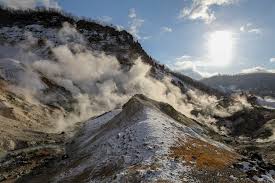
Jigokudani's volcanic healing waters: Jigokudani or Hell Valley gets its name for its eerie sulphureous landscape full of hot steam vents and sulfurous flowing hot water streams. The volcano-made hot waters of this valley are the main source for the Noboribetsu Onsen's hot spring waters. And it's not all about bathing in Jigokudani: you can also go hiking, before bathing, in the wooded hills above the area. One popular path leads to Oyunuma Pond, a sulfurous pool of hot water. Next door is an even hotter mud pond. The hot (literally) Oyunumagawa River flows through the forest, reminiscent of a scene from King of Thrones or Lord of the Rings.
The amazing Ainu worlds around the Upopoy Ainu Museum: Upopoy translates as "singing together" in the Ainu language. And the Upopoy Ainu Museum, just inland from Shiraoi Station, is considered to be the most extensive Ainu museum and learning center in the country. Remember, the indigenous Ainu were the first settlers of Hokkaido. And eventually, after being driven out of Honshu Island by the so-called Japanese people, their last refuge in Japan. The Ainu are well portrayed in Hayato Miyazaki's famous Princess Mononoke anime film as are the universal forces of the natural world the Ainu respected so deeply. The extensive Ainu museum park is home to the National Ainu Museum and a number of other facilities where you can learn about and experience Ainu culture. Lake Poroto, a small but beautiful lake, is also part of the park. Ainu dance and music performances, Ainu cuisine and crafts can all be experienced in the park.
The wonders of big Lake Toya & pristine Lake Shikotsu: Lake Toya, a little NW of Shiraoi, is home it's own hot springs and an active volcano (Mount Usu; it last erupted in 2000). The lake, known as a caldera lake (formed by volcanic activity) is super popular for fishing, hiking, and camping. Lake Shikotsuko like Lake Toya is also a caldera lake. The lake shore is hardly developed. The only exception is Shikotsu Kohan, a small, tourist town along the lake's western shores. In Shikotsu Kohan tourists can rent boats, bicycles and even scuba gear. And in the summer months both of these lakes offer great freshwater swimming opportunities. Lake Shikotsu is surrounded by mountains and one of them, Mount Tarumae, is an active volcano (the last eruption was in 1981) that offers interesting crater views and a couple of steeps but rewarding trails. At the very northern edge of Lake Shikotsu you will find a single ryokan inn called Marukoma Onsen and it's superb lakeside hot spring baths (gender separated).
Nibutani, where the Ainu live! Nibutani Kotan is less than an hour NE of Noboribetsu. It is the area of Japan with the highest number of Ainu residents. So, if you go, be extra courteous and aware. Nibutani Kotan one of the best places in Japan, if not the best, to learn about and experience Ainu culture. Here you will find the Biratori Municipal Nibutani Ainu Culture Museum, the Historical Museum of the Saru River, and the Ainu Culture Information Center of Biratori, as well as a gathering of restored Ainu cise houses. These traditional Ainu homes are also used to showcase the amazing craft working methods of Ainu artisans. These experiences include Ainu ita carving and embroidery. The nearby Street of Artisans, lined with Ainu artisan workshops, leads to the Biratori Ainu Crafts and Heritage Center Urespa and the Kayano Shigeru Nibutani Ainu Museum. If you learn any Ainu word then thank you or “iyairaykere” would be a wise choice!
Japan private travel content by Your Japan Private Tours' (established in 1990) founder Japan travel expert Ian Martin Ropke. I have been planning, designing, and making custom Japan private tours on all five Japanese islands since the early 1990s. Your Japan Private Tours specializes in bespoke travel for private clients (I do not work with agents) including exclusive excursions, personalized experiences, and unique adventures. I am 100% client-centric and total individual attention. Consider my Japan travel services for your next trip. And thank you for reading my content. Learn more!
- Indexed full list of all my blog posts | articles.
- Indexed full list of all my Japanese culture essays.
Japan private travel content by Your Japan Private Tours' (established in 1990) founder Japan travel expert Ian Martin Ropke. I have been planning, designing, and making custom Japan private tours on all five Japanese islands since the early 1990s. Your Japan Private Tours specializes in bespoke travel for private clients (I do not work with agents) including exclusive excursions, personalized experiences, and unique adventures. I am 100% client-centric and total individual attention. Consider my Japan travel services for your next trip. And thank you for reading my content. Learn more!