Japan private tour insights for the Tohoku region and Aomori
The Tohoku Region, literally the "North East Region", is well known with Japanese domestic travelers for its unique and large countryside landscapes (old farms and forests), mountains, lakes, hot springs, and one of the harshest and beautiful winter landscapes in Japan.
Foreign travelers rarely consider the Tohoku area. The one exception for in-the-know foreigner travelers is Matsushima Island in Miyagi Prefecture, which is quite close to Tokyo and its huge population of potential travelers. Miyagi Prefecture is in the southeast corner of the Tokoku region just south of Fukushima prefecture (site of the 2011 earthquake-tidal-wave-nuclear disaster; see below). Matsushima is one of Japan's most celebrated and visited scenic spots because of its unique ocean bay dotted with over 260 pine-covered islands. The exotic pine islets in the Miyashima archipelago are one of Japan's Three Views.
Nearly all adult foreigners who follow the news will know of the Tohoku region from the Fukushima earthquake, tsunami tidal wave, and nuclear disaster, which began on March 11, 2011. Nearly 20,000 souls perished from the earthquake's destruction and the massive tidal waves that followed. The Tohoku Fukushima disaster of 2011 literally shook my world as my family was living in Kyoto at that time. My daughter was enrolled in an American private school and was on spring vacation when the disaster began.
Though the center of the disaster was nearly 700 kilometers northeast of Kyoto, the entire country of Japan was in disaster mode. This was largely, if not entirely, caused by the near meltdown of the Fukushima nuclear reactors that were stupidly built (by General Electric) for the Tokyo Electric Power Company (TEPCO), Japan's biggest electricity producer. The nuclear reactor site was only a few hundred meters from the sea and nearly at sea level. So, when the tidal wave struck it caused an international nuclear disaster that is still ongoing but stable.
Fukushima was lucky that the event was contained, not by human brilliance, but because nearly 100 percent of the massive radioactive leakage bled directly into the Pacific and was largely diluted (and even detected on the west coast of North America). Damage to local fisheries and farms was enormous but within a few years even these food producing areas recovered somewhat. Believe it or not!
But for the first six months of life in Kyoto after the Fukushima event all of Japan was on edge, especially in Tokyo where the earthquake has fairly serious effects given that Fukushima was less than 200 km directly northeast of Tokyo. We even fled to Thailand for the first three weeks after March 11, 2011. My wife had experienced the Chernobyl disaster in Vienna when she was 16 and it shook her entire Austrian and East European world much like Fukushima did to Japan.
But I digress. Let's get back to the immense charms of the Tohoku region and why it is probably the most overlooked tourist destination for foreigners. Basically, 95% of foreign travelers to Japan visit the band of land that connect Tokyo with Osaka (Kyoto), Hiroshima and Fukuoka. Hardly any foreign tourists explore the Tohoku region because they have never heard of it! It's my job as professional Japan travel expert, itinerary designer and travel lover to make sure that more people understand the exceptional value of the Tohoku region in any season. Of course, as a place that is way off the beaten track, the Tohoku region will always be as pristine and diverse as it always has been.
Tohoku first caught my attention in the late 1990s through my close working relationship with a high-end German Japanese antique dealer. It was through him that I realized that the Tohoku area is home to roughly one million multi-generation farms and farmhouses. It's a rich rice and agriculture zone and always has been (at least after the Ainu indigenous were driven north into Hokkaido) and this accounts for what is Japan's richest source of antiques.
Many of Tohoku's ancient farmhouses are sold because the inheritors don't want the burden of running a farm or maintaining an old, usually large, Japanese family farmhouse. And under these circumstances the entire contents of the house are "disposed of" and that includes enormous collections of antique Japanese wooden tansu chests, tables, textiles, farming artifacts, and religious and art objects. My German antique dealer friend more or less cornered the market for antique tansu chests for all of Japan by paying top dollar to the local antique dealers who were commissioned to sell the antiques in these farmhouses. So these local antique dealers gave the German dealer the first opportunity to buy as he paid so well.
And in learning of all this I realized that Tohoku must be a vast old farmland area (huge rice producer) interspersed with old forests and colorful local people watching scenery. I have had maybe five Japan private tour clients since 1990 who ventured to the Tohoku region. Three visited the Matsushima Bay area and two toured the best of Aomori Prefecture, which is where I will begin my blog posts on the region. The prefecture is the closest to Hokkaido island where my previous blog post left off.
This post will focus on Aomori City the capital of the prefecture, and Mount Osore or Fear Mountain northeast of the city.
The rest of this post covers:
Japan private travel content by Your Japan Private Tours' (established in 1990) founder Japan travel expert Ian Martin Ropke. I have been planning, designing, and making custom Japan private tours on all five Japanese islands since the early 1990s. Your Japan Private Tours specializes in bespoke travel for private clients (I do not work with agents) including exclusive excursions, personalized experiences, and unique adventures. I am 100% client-centric and total individual attention. Consider my Japan travel services for your next trip. And thank you for reading my content. Learn more!
Aomori City's basecamp attractions
Aomori City, the capital of the Tohoku region's Aomori prefecture, is rich in culture and attractions and fairly small as a city (only 270,000 inhabitants spread out over a large area). This major historical port town was the departure point for the Hokkaido ferry before the Seikan Undersea rail and car tunnel was built to link the two islands. Aomori City is still the main port for car ferries. For the Japanese, Aomori is most known for its wild and colorful summer Nebuta Matsuri festival. The city is also a convenient basecamp for exploring the entire region. The train links from the city to the main attractions in the area are world class and frequent.
Aomori's best high-value attractions:
Aomori's Nebuta Matsuri festival: Nebuta and Neputa are a type of summer festival celebrated in towns across Aomori Prefecture. The biggest, by far, of these local Nebuta Matsuri festivals takes place in Aomori City, annually from August 2 to 7 for over 300 hundred years. The festival's reputation is built on the spectacle of its parade of enormous lantern floats, flanked by large taiko Japanese drums, musicians and dancers. The festival's two dozen floats are built by local neighborhood teams. They are constructed of painted washi paper draped over a wire frames, and usually require an entire year to make for the next year's festival. The parade floats can be nearly nine meters wide and five meters high. They are decorated in bold graphic ways to represent gods, historical or mythical Japanese and Chinese figures, kabuki actors, and characters from Japan's wildly popular historical TV series. These massive parade floats are pushed down Aomori's streets by people but don't forget that each float is accompanied by colorfully dressed teams of musicians and hundreds of dancers (called haneto). The parade route is nearly 3 km long! A two-hour fireworks display along the Aomori City waterfront brings the festival to an end in an unforgettable explosion of sky light.
Nebuta Warasse museum: If you can't make it to Aomori City's early-August Nebuta Matsuri in person, you can still experience the festival through the Nebuta Warasse museum in Aomori's waterfront district. Red goldfish lanterns, a key symbol of the festival, hang along the museum's main corridor that leads to actual floats built for past festivals. On some weekends and holidays, Haneto dance performances are held at the museum, accompanied by live taiko drum and flute music. The museum has a restaurant and a superbly managed museum shop.
Sannai Maruyama Archaeological Site Jomon Site: Aomori's Sannai Maruyama Archaeological Site is one of the biggest and most complete villages from the Jomon Period (roughly from 13,000 BC to 300 BC). The site was discovered by accident during the construction of a baseball field! The village site has more than 700 structures and dwellings including long houses, storage buildings, roads, and waste and burial pits. The site's present structures, built for visitors, are reconstructions. Some are huge buildings that visitors can enter and explore. The adjacent Jomon Jiyukan musuem exhibits objects excavated from the Jomon site and uses various media to show how Japanese people lived so long ago. Everything from Jomon period clothing, tools, crafts and toys. The site is conveniently located almost next to the Aomori Museum of Art, which was designed from structural elements found on this ancient human habitation.
Aomori Prefecture's celebrated Fear Mountain worlds
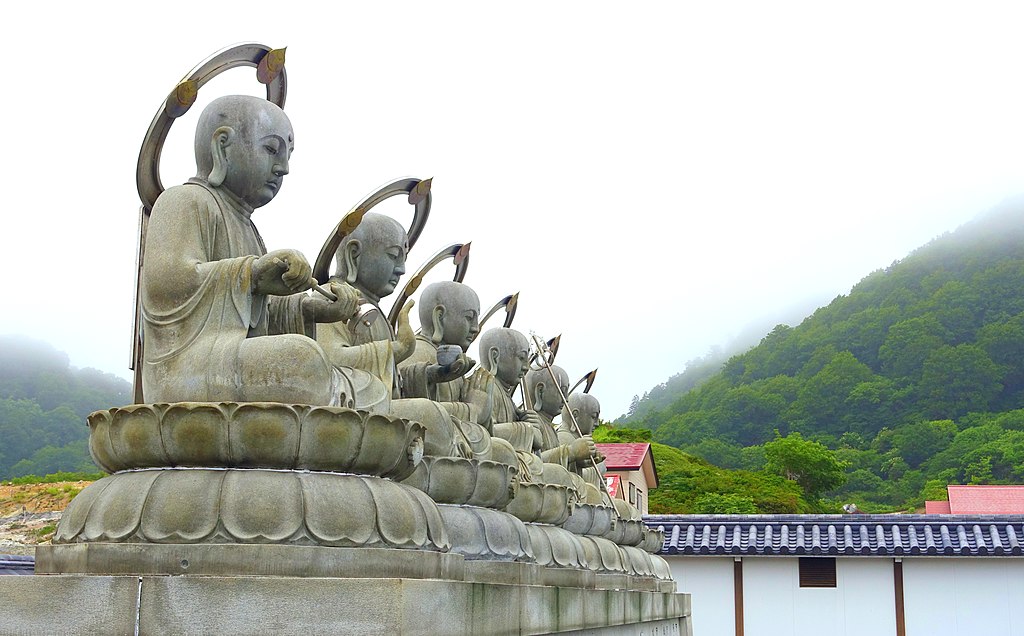
Known as Mt. Osore or Osorezan, this holy site ranks among the top three sacred locations in all of Japan along with Mt. Koya (southeast of Osaka in the deep mountains of Mie Prefecture) and Mt. Hiei (overlooking the Kyoto City Valley to the northeast). The remote peak of Mt. Osore is also known as Fear Mountain. The mountain reveals a side of Buddhism that few people know of. I heard "rumors" of Fear Mountain in the mid to late 1980s but it seemed so far away. But I always knew that the mountain was a place for Buddhist rituals that border on witchcraft or magic and also death worship.
No written records tell us when Osoresan became a religious or spiritual site. Legend says that the site was first discovered about 1,200 years ago by the Buddhist monk Ennin. According to the legend, he was studying Buddhism in China, when he had a vision in which a ghostly spirit commanded him to return to Japan and travel east. After walking for thirty days from Kyoto, the monk was promised (in his vision) that he would find a sacred mountain where he should carve a statue of the Bodhisattva Jizo and thereby establish a new center for Buddhist training (and worship). Of course, Ennin didn't find Mount Osore in 30 days. It probably took him a year to get to the northern tip of Honshu from Kyoto if not longer. But all the same Mount Osore is entirely linked with the "idea of" the Jizo Bodhisattva.
The Jizo Bodhisattva is revered in East Asian Buddhism and generally depicted as a Buddhist monk with a halo above his head and carring a staff. His name can be translated as "Earth Treasury", "Earth Store", "Earth Matrix", or "Earth Womb". Jizo is part of every neighborhood in Japan and strongly connected with children, travelers and firemen. Jizo's vow was to take help all beings pass through the six worlds of Buddhism and not to achieve Buddhahood until hell is empty. In Japanese culture, Jizo is seen as the bodhisattva or savior of hell-beings, the guardian of children, and patron deity of deceased children and aborted fetuses.
Mount Osore's Fear Mountain moniker comes from its "weird" religious practices, and a landscape that is extremely eirie and scary because it's an active and living volcanic wilderness. At first sight it looks like a grey and barren wasteland with hot fumes erupting all over it. No trees. Just rocks and empty space that seems more like Hell than anywhere else in Japan.
But Mt. Osore is not all gloom and doom for those that appreciate landscapes as landscapes without judgement. In the West we romanticize everything and thus divide landscapes into either beautiful or ugly. Mount Osore would be viewed as ugly and to be avoided "like the plague." But if you are objective, like any pure Buddhist (especially Zen Buddhists), then a landscape is a landscape and all have aspects of beauty and the unavoidable implications of life and death.
Osoresan is home to some truly alien vistas. Chief among these is the beautiful but poisonous, Lake Usori, surrounded on all sides by eight towering mountains. These eight peaks are symbolic of the eight petals of the lotus, symbolizes enlightenment in Buddhism. This is because the roots sink into the mud of our subconscious but from these roots a beautiful flower is created.
Mt. Osore is also the home for a unique tradition of spiritually endowed mediums known as Itako who are all women. They are also all blind! In modern times the mountain has been home to about twenty living practitioners of this ancient tradition. Itako have been trained to communicate with the dead, sometimes beginning as young children. The training is long and consists of extremely challenging ascetic practices including long cold-water rituals. ritualized exposure to cold water. Mount Osore's Itako traditions predate the Edo period (1603–1868). In that era, blindness was associated with spiritual power and insight. Itako carry a few distinctive artifacts including a beaded necklace used in rituals.
Mount Osore's Bodai-ji Temple hosts a festival every year (July 22-24) that brings together all practicing Itako and countless grieving families from across the nation hoping to communicate with the dead. As a Japan travel expert I would recommend avoiding Mount Osore at all costs during these three days as the crowds are beyond imagination and the area is heavy with mourning. However, if you have recently lost a loved one then the Itako connection becomes uniquely attractive for many people.
Mt. Osore is believed to be a Buddhist gateway to hell, and it sure appears that way as you walk slowly through the thermal vent riddled landscape.
Mt. Osore is only open from April to November. In winter it's an inaccessible winter landscape, as if the volcanic mountain is asleep beneath a thick white blanket of snow. Mt. Osore isn’t easy to reach, and you have to spend quite a bit of money to get there. It's on the Shimokita Peninsula and is a long day trip from Aomori City. The best basecamp for Osoresan exploration is the town of Hachinohe southeast of the mountain on the Pacific Coast. For the really keen, the shukubo or temple lodgings on Mount Osore allow you to be within walking distance of the entire landscape 24/7.
- Indexed full list of all my blog posts | articles.
- Indexed full list of all my Japanese culture essays.
Japan private travel content by Your Japan Private Tours' (established in 1990) founder Japan travel expert Ian Martin Ropke. I have been planning, designing, and making custom Japan private tours on all five Japanese islands since the early 1990s. Your Japan Private Tours specializes in bespoke travel for private clients (I do not work with agents) including exclusive excursions, personalized experiences, and unique adventures. I am 100% client-centric and total individual attention. Consider my Japan travel services for your next trip. And thank you for reading my content. Learn more!