Japan private tour tips for central Hokkaido: flower fields & big park
Before we get into the main part of this post (Hokkaido's Daisetsuzan National Park and Furano & Biei), I would like to "talk" a little about Hokkaido's wildlife, namely the Ezo wolf, the Ezo red fox, and the Ezo brown bear).
Hokkaido's Ezo wolf is now, unfortunately, an extinct subspecies of gray wolf. The Ezo wolf was related more to North American wolves than Asian ones.
Hokkaido's Ezo wolf was exterminated during the Meiji Restoration period (1868-1912), when American-style poison bait (strychnine) was effectively adopted by the Japanese. Hokkaido, at that time, was a booming place for beef cow ranches. It was also the new frontier for Japan's shift from rice to potatoes and corn (eaten by the Japanese at home and used as ingredients in processed foods and in Western restaurants).
The wolves were a problem or framed as problem as they did kill horses and deer (which the indigenous Ainu prized for meat). Mass poisonings took care of this supposed problem and the Ezo wolf vanished overnight. RIP.
The Ainu revered the wolf as the deity known as Horkew Kamuy ("howling god"). Before the modernization of Hokkaido in the late 19th century, Ainu hunters would leave portions of their kills for wolves. Due to Ezo wolf's special status in Ainu culture, hunters were forbidden by their tribes from killing wolves with poison arrows or firearms. But that all came to an end when Westernization and American viewpoints on wolves swept the island. Sad story to be sure.
The Ezo red fox is a story with a happy ending. It is widely distributed across Hokkaido. In the Ainu language, the Ezo fox is called cironnup, sumari, kimotpe or hurep. Ezo red foxes in Shiretoko National Park migrate from their home territories in April and begin foraging for human food in nearby Utoro city. From the 1980s onwards, Ezo red foxes have settled permanently on the edges of Sapporo and other big cities, much like in North America.
The other big animal on Hokkaido is the Ezo brown bear (also known as the Russian grizzly bear) and it is also alive and well (unlike the Ezo wolf!). The Ezo bear is about the same size as Kodiak bears in North America. The Ezo bear is very similar to the Kamchatka brown bear, with the exception of a longer skull and a lower forehead. In the first half of the 20th century, nearly 150 people died from Ezo bear attacks. Between 1962 and 2008, 33 more people were killed in bear attacks. So, when you are in Hokkaido be sure to give these bears the same respect and distance as you would with bears in North America. They are not dangerous but sometimes they become threatened by stupid (or unlucky) people. Better safe than sorry!
The rest of this post covers:
- The flower & foodie landscapes of Biei & Furano
- The summer & winter wonders of Daisetsuzan National Park
Japan private travel content by Your Japan Private Tours' (established in 1990) founder Japan travel expert Ian Martin Ropke. I have been planning, designing, and making custom Japan private tours on all five Japanese islands since the early 1990s. Your Japan Private Tours specializes in bespoke travel for private clients (I do not work with agents) including exclusive excursions, personalized experiences, and unique adventures. I am 100% client-centric and total individual attention. Consider my Japan travel services for your next trip. And thank you for reading my content. Learn more!
The flower & foodie landscapes of Biei & Furano
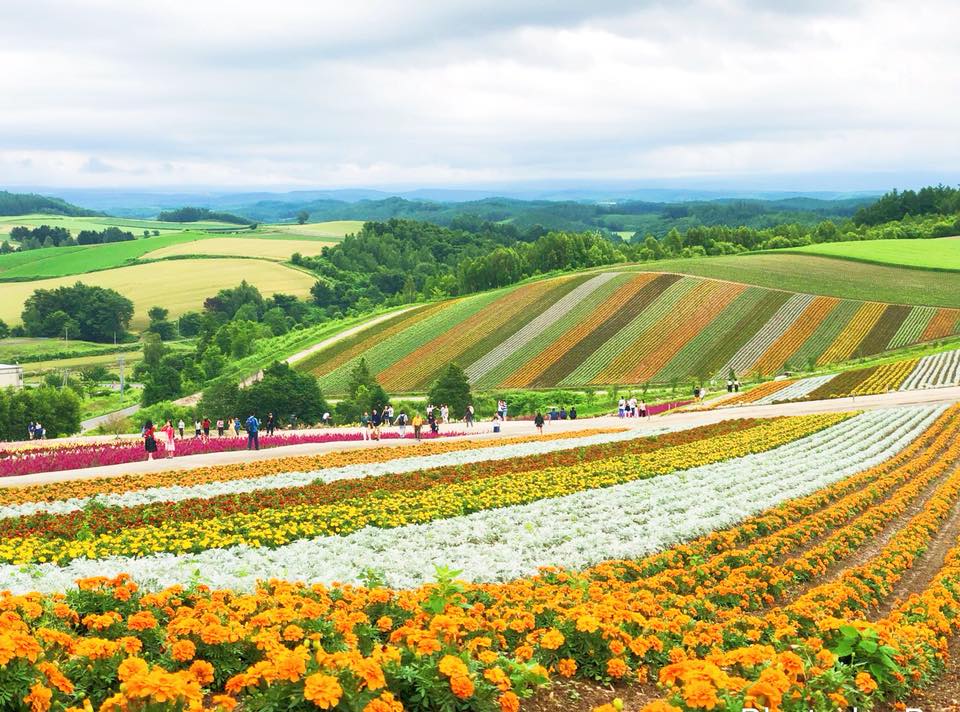
The flower-flooded towns of Furano and Biei lie in the center of Hokkaido and are easily accessible by train from Sapporo (and Daitsetsuzan National Park, see below). The towns have only been on the radar of tourists since the 1980s, mostly with the Japanese in those days. Remember, in the 1980s the global newspapers and magazines were awash in the images connected to the booming French perfume industry (Italian too) and perfume required vast fields of lavender, roses and other beautiful plants. By the late 1990s these incredible rolling hills of flowers in southern France (primarily) became tourism meccas for Southeast Asian (and northern Europeans and North Americans). And Instagram only made these areas more famous!
Japan has more than few perfume and makeup makers. Shiseido was for the longest time a household word in Japan and the rest of the world. And companies like Shiseido learned from the changes in France and thus needed their own vast flower fields. This is how Furano became as trendy (if not more so) than the southern flowers fields of France. And I must admit the experience of seeing such flower landscapes at dawn, on a full moon night or a great sunny day is impressive. [Alaska, before I forget, is world famous for its flowering vistas but all of these plants are native and not related to perfume or food or agriculture.]
Furano & Biei are at their most popular and most picturesque in July but August is also amazingly beautiful. The area also has a dynamic winter scene both for downhill skiing and cross country skiing (and also snow shoeing). Furano (and other locations in Hokkaido, like Otaru) has successfully developed into a place where the scenery is stunning and the cuisine and beverage options are world class (think wine, juice, desserts, cheese, top great beef and chicken, corn, potatoes and you get the picture).
Furano & Biei are part of the same landscape but most of the modern trendy developments have been in Furano (to the south of Biei). This makes Biei just a bit quieter and thus more relaxing (for couples and families interested in chillin and seeing beauty by day). Bei has the same gently rolling hills and endless flowers fields as Furano. And seeing the town (a large green zone) is possible by bicycle, hired sedan + driver (Yen 8,000/hour), and hiking. Something for everyone! Some of Biei's flowering field areas have taken on unique names such as "Patchwork Road," and "Panorama Road". And some tree formations have also become Instagram memes (just like the European countryside avenues that resemble tree tunnels and often trees with unique beauty traits). Among these famous tree formations are a row of larch trees on Mild Seven Hill (made famous by a TV and magazine tobacco commercial), a poplar tree called the Ken and Mary Tree (from a wildly popular Japanese car commercial), and the Seven Star Tree (made famous, again, by a TV and magazine tobacco commercial). Biei's Shikisai Hill, a huge flower park with various flower fields (including lavender) is beautiful and can be viewed by walking along the trails, renting carts or riding on tractor-pulled wagons. In winter, you can zoom across the gentle rolling slopes on snow mobiles. If you appreciate photography, then Biei's Takushinkan (landscape photography by renowned photographer Maeda Shinzo and his eldest son Akira) should not be missed!
Last, but not least, the Furano Ski Resort is considered to be one of the best on the entire island of Hokkaido. So, if Niseko has just too many foreigners for your liking then the Furano Ski Resort is the place to ski with only the Japanese (more or less). It's a great resort for families (Family Snowland) but it also has long runs with good powder and a large for other snow related activities. The resort has two peaks with long runs (some used for World Cup races). The resort has a wide range of accommodation ranging from two big Prince Hotels (4 star), minshuku bed & breakfasts, pensions and small hotels.
The summer & winter wonders of Daisetsuzan National Park
Daisetsuzan National Park is the largest park on the island of Hokkaido. The park is a giant chunk of unspoiled wilderness, something that isn't that easy to find anywhere in the world truth be told. Daisetsuzan is perfect for hiking, seeing deer and brown bears (from a distance natch!). It is also the place where in Japan to experience fall foliage colors and the start of Japan's snowy winters.
Top attractions in Daisetsuzan:
Asahidake Onsen: Asahidake Onsen, a small onsen hot spring resort village at the foot of Hokkaido's tallest peak, Mount Asahidake (2290 meters), has distinctive wooden lodges, a couple of big hotels, and a great youth hostel. This is a place to get away from everything! Daisetsuzan's well-known Asahidake Ropeway transports tourists from the Asahidake Onsen town to the upper slopes of Mount Asahidake (see above). The alpine fields in summer on the mountain are wildly picturesque (a version of Switzerland to be sure). From late June to late September Ashidake Onsen welcomes many hikers, beginners and advanced hikers. Skiing is killers on the slopes here from December the begining of May.
Kogen Onsen: Daisetsu Kogen Onsen is situated 1260 meters above sea level on the eastern side of Daisetsuzan National Park. It's a tiny place with a single hot spring lodge. The village is also the beginning of a highly popular circular hiking trail through the highlands (with lots of marshes). The area is home to large populations of brown bears and hikers need to be prepared (with tools and education).
Sounkyo Onsen: Sounkyo is probably the most touristy resort in Daisetsuzan National Park but that doesn't mean it should be avoided. Not at all. It's a classy place and pretty easy to get to by taxi from the nearest train station. The resort is overshadowed by Mount Kurodake, which is almost 2000 meters high. Sounkyo Onsen is the start of the Kurodake ropeway and chair lift. The mountain becomes a ski paradise in winter and ranks as one of the first ski resorts in Japan to open for the season. The river gorges (with 100-meter cliffs on either side) at the base of Mount Kurodake are spectacular Sounkyo has a few public hot spring baths and private ones at the town's numerous ryokan inns. The area is also famous for its two waterfalls, the Ginga no Taki and Ryusei no Taki , and both are 100 meters high!
- Indexed full list of all my blog posts | articles.
- Indexed full list of all my Japanese culture essays.
Japan private travel content by Your Japan Private Tours' (established in 1990) founder Japan travel expert Ian Martin Ropke. I have been planning, designing, and making custom Japan private tours on all five Japanese islands since the early 1990s. Your Japan Private Tours specializes in bespoke travel for private clients (I do not work with agents) including exclusive excursions, personalized experiences, and unique adventures. I am 100% client-centric and total individual attention. Consider my Japan travel services for your next trip. And thank you for reading my content. Learn more!