Japan private tours insights for Iwate Prefecture Part 2
Before we get into my last post on the off-the-beaten-track worlds of Tohoku's Iwate Prefecture, I would like to rave a bit about Okinawa's unique Kaichu Doro (Mid-sea Road). This is Japan's ONLY causeway where you can literally access an almost endless seabed landscape during low tide. The causeway itself is for car traffic but during low tide the sea floor is just a few meters away for strolling and marveling at marine life in tide pools.
The Kaichu Doro (built in 1972) connects four tiny islands (Henza, Miyagi, Hamahiga, and Ikei) to the Katsuren Peninsula on the SW coast of Okinawa's main island (where the Naha international airport is). The "route" has been used by local fishing families for generations for what is known as tide fishing or tidal pool fishing. The islands connected by this causeway are virtually "untouched." Virtually! Henza Island (the furthest away only has one convenience store!).
Island families still practice traditional tide fishing, collecting trapped fish from natural pools formed when the tide recedes. The best viewing times coincide with morning low tides when local fishermen work the exposed seabed. The best months, according to the locals, are from October to March (good weather and great visibility).
The shallow shoal system extends far beyond the causeway boundaries, creating vast areas of walkable seabed during extreme low tides.
Since 2015, the causeway has been illuminated with a range of programmed lighting patterns, resulting in spectacular nighttime displays focused on the area's ocean history.
The rest of this post covers:
- Hiraizumi from the Heian period (1109) to now
- Other high-value travel destinations in Iwate Prefecture
Japan private travel content by Your Japan Private Tours' (established in 1990) founder Japan travel expert Ian Martin Ropke. I have been planning, designing, and making custom Japan private tours on all five Japanese islands since the early 1990s. Your Japan Private Tours specializes in bespoke travel for private clients (I do not work with agents) including exclusive excursions, personalized experiences, and unique adventures. I am 100% client-centric and total individual attention. Consider my Japan travel services for your next trip. And thank you for reading my content. Learn more!
Hiraizumi from the Heian period to now
The town of Hiraizumi may be small (less than 8,000 inhabitants) but when it comes to history the town is incredibly older. In the late Heian Period (794-1185), when the Nara-Kyoto Fujiwara clan ruled Japan's political stage, Hiraizumi was selected to be the power based for the north Fujiwara clan (in the year 1105 to be exact). It's kind of amazing, when you think that the distance from imperial Heian Kyoto to Hiraizumi is nearly 1,000 kilometers!
After its establishment in 1105, Hiraizumi prospered culturally and politically. It even threatened Heian Kyoto's preeminence but only briefly. Hiraizumi's powers were effectively wiped out in 1189 by Minamoto Yoritomo, who established Japan's first shogun capital in Kamakura just west of Edo-Tokyo. Yoritomo went to Hiraizumi with his forces to find his brother and bitter enemy Yoshitsune (who learned his fighting skills from the tengu monks in Kurama, just north of downtown Kyoto). Yoritomo's forces destroyed Hiraizumi and it never really recovered. But what was not destroyed has continued to attract travelers ever since. Hiraizumi is a top three historical site in the Tohoku region and the oldest by far.
The best attractions in ancient Hiraizumi:
900-year-old Chusonji Temple: Chusonji Temple, Hiraizumi's most famous tourist attraction, was founded in 850 as Tendai sect Buddhist temple (the headquarters of the Tendai sect is Mount Hiei, which overlooks the Kyoto Valley from the northeast corner). When the temple's power peaked the precinct was home to numerous elaborate buildings built along a series of networked paths that are still used today. Only two "original" Heian period buildings remain today. The most impressive, for most people anyway, is Hiraizumi’s 1124 Konjikido Hall, which is completely covered in gold. The 1108 Kyozo Hall also survived and lucky for us. The building is an immense Buddhist scripture scroll library that was priceless in the early 12th century and also today! Chusonji also has an exquisite Noh theater stage.
Geibikei Gorge: Iwate Prefecture's Geibikei gorge, just outside of Hiraizumi town, can be enjoyed from flat-bottomed boats steered by a single boatman holding a long pole. The gorge scenery is beautiful in any season but for most the autumn foliage is the most popular time (late Oct to early Nov). The gorge is home to ducks and carp fish, and you are allowed to feed them from the flat-bottomed tour boats.
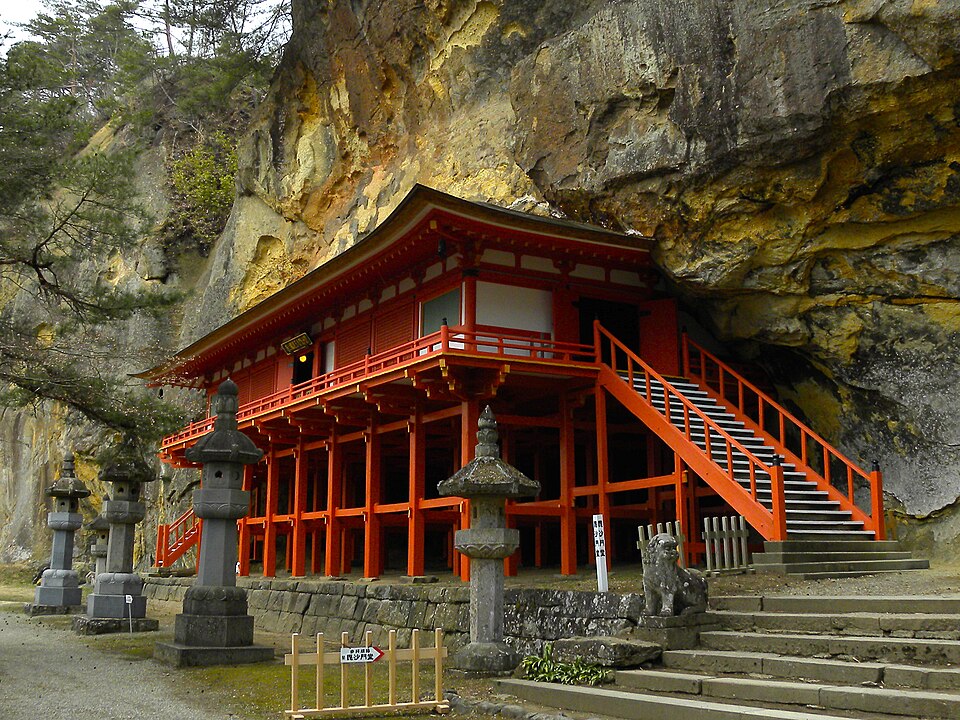
Takkoku no Iwaya Temple: This temple is notable as it was built at the base of stunning cliff, and part of the temple is actually built into the cliff's stone base. The temple was built to honor the Japanese god of war (Hachiman) during Japan's push north in the late 9th century (i.e., the Heian period). The winners of this "colonial" campaign where the Japanese of Kyoto and the losers were the indigenous Emishi or Ainu people (who now survive on the island of Hokkaido; about 35,000 Ainu have survived; not many but much better than none at all!).
Takadachi Gikeido: This memorial is devoted to Minamoto Yoshitsune, who was killed (or better said forced to commit ritual suicide) by his brother in 1189. His brother, Minamoto Yoritomo, went on to become Japan's first shogun from his military base in Kamakura, just west of Tokyo, in the Kamakura period (1184-1333). The memorial is home to an actual-size wooden statue of Yoshitsune, who was given refuge in Hiraizumi by the local Fujiwara administration. But in the end he was betrayed by the Fujiwaras and forced to commit seppuku (ritual suicide) to avoid the dishonor of being captured. And soon after Yoshitsune died, Yoritomo's forces almost completed destroyed Fujiwara Hiraizumi.
Other high-value travel destinations in Iwate Prefecture
Iwate's part of the Hachimantai region: Iwate's mountainous Hachimantai area (which is also part of Akita Prefecture) is famous throughout the country for its ancient onsen hot springs. Hachimantai is part of the southern section of the Towada-Hachimantai National Park and really far from the madding crowds of big city life in Japan. The area is home to amazing hot springs, ryokan inns and weird volcanic landscapes (networked with safe hiking trails).
Iwate's part of the stunning Sanriku coastline: Iwate's Sanriku coastline is pretty close to Tokyo and very popular with Tokyoites who recognize travel value. Iwate's Sanriku shoreline is nearly half of the entire Sanriku stretch (running south from Aomori Prefecture through Iwate into Miyagi Prefecture) is home to many tranquil bays and coves, which often feature dramatic cliff-fringed shores. The best areas of the Sanriku Coast are part of the Sanriku Recovery National Park, and this includes the Kitayamazaki Coast, which stretches about 10 km along the coastline of northern Iwate Prefecture. The Kitayamazaki Coast is home to cliffs as high as 200 meters. The Kitayamazaki Observatory at the north end of this coastline has three observation decks that offer stunning views. The Sanriku Recovery National Park is also home to gift shops, places to eat and sleep, and a series of walking paths (some lead down to the sea). Many tourists view the Kitayamazaki coastline from sightseeing boats. Another section of the coast, called Unosu (translated as cormorants' nest) is about 5 km in length and home to all kinds of birds (including osprey and eagles) who nest on the 200-meter-high cliffs.
Jodogahama paradise beach: Many international cruise ships stop at Miyako Port, and I have worked with a few Japan private tour clients interested in seeing the best of the Miyako Port area. I have usually included Jodogahama Beach just north of the port, especially towards sunset. Jodogahama is also part of the Sanriku coastline (and the Sanriku Recovery National Park). It is a distinctive beach landscape characterized by a white sea-rounded pebble shoreline with classic pine tree forests in the background. The nearly always serene waters off the beach, which are sheltered from the open ocean, are dotted with rough, rocky islands.
Iwate's amazingly deep Ryusendo limestone cave: Iwate's Ryusendo limestone cave ranks as one of the top three limestone caves in Japan (the Japanese love to rank things and always have!). The cave is in the mountainous part of Iwate and is said to penetrate nearly 5 km beneath the mountain! Only the first 3.5 km have been charted since the cave was discovered in the 1920s. Roughly one kilometer of the Ryusendo Cave, including a section along an underground river, is open to the public and can be explored via a series of stairs, walkways and bridges that lead to a couple of deep underground lakes lit up with underwater illumination tech. One lake reaches a depth of 120 meters making it the deepest underground lake in Japan (so far). The cave is home to a unique bat ecosystem consisting of a few species that hang from the cave ceiling, when not out in the open-air catching food. The beaches along the Goishi coastline: The southern Iwate Prefecture Goishi coastline is known for its stunning rocky beaches and cliff settings. This coastline is also part of the Sanriku Recovery National Park. Go-ishi is a reference to the perfectly round black stones used in the Japanese board game of Go (like Othello). The smooth stones are constantly being worn down by the churning Pacific Ocean and you can actually hear them (as if they were in a washing machine!). Lovely foot paths have been built along the cliff tops overlooking the beaches including a number of excellent observation platforms.
Iwate's massive Kesennuma Fish Market: The Kesennuma City Fish Market is one of the biggest in Japan. And every normal business-day morning between 6:00 and 8:00 the public (and tourists) can see lively fish auctions. The Kesennuma catch includes tuna, shark and swordfish (year-round) and seasonal catches that include sanma saury, katsuo bonito and a number of different shellfish varieties. Though shark is not common in the restaurants of Japan the fish is important for its fins, for making fish paste, fish leather and in some "health" supplements. The second floor of the market is perfect for viewing all the action, which can be dangerous if you are in the actual rush of vehicles and people on the ground floor. Next door, you can eat some of the freshest and best seafood in all of Japan.
Tono town for folklore & thatched farmhouses: The rural landscape around Tono town in the highlands of central Iwate is well-known for its satoyama traditional farm culture including its L-shaped thatch roofed farmhouses. However, Tono is also "famous" for its Japanese folklore legends related to supernatural spirits and fantastical creatures. Tono's folkloric legends have been passed down orally by generations of storytellers and only recorded in book form in the last few years of the Meiji Period (1868-1912). The resultant book, the "Legends of Tono," was published in 1910 and was one of the first such folktake collections every published in Japan. Oral story telling performances (in Japanese only, unfortunately) are still held regularly in the area's folk villages and museums. The best-loved and most famous of Tono's creatures is the kappa water sprite that sort of looks like a human with a turtle-like head. Kappa are known to "hang out" near rivers, streams and ponds, and are also associated with drinking sake rice wine.
- Indexed full list of all my blog posts | articles.
- Indexed full list of all my Japanese culture essays.
Japan private travel content by Your Japan Private Tours' (established in 1990) founder Japan travel expert Ian Martin Ropke. I have been planning, designing, and making custom Japan private tours on all five Japanese islands since the early 1990s. Your Japan Private Tours specializes in bespoke travel for private clients (I do not work with agents) including exclusive excursions, personalized experiences, and unique adventures. I am 100% client-centric and total individual attention. Consider my Japan travel services for your next trip. And thank you for reading my content. Learn more!