Japan private tours insights: Tokushima Prefecture Part 2
Content by Your Japan Private Tours' (established in 1990) founder Japan travel expert Ian Martin Ropke.
I have been planning, designing, and making custom Japan private tours on all five Japanese islands since the early 1990s. Your Japan Private Tours specializes in bespoke travel for private clients (I do not work with agents) including exclusive excursions, personalized experiences, and carefully chosen off-the-beaten-track places.
I am 100% client-centric and total individual attention. Consider my Japan travel services for your next trip. And thank you for reading my content. Learn more!
The United States and Australia are widely regarded as the world's top surfing locations. But in Japan, top surfers prefer the world-class river mouth waves at Tokushima's Kaifu Point (east side of Shikoku Island), especially during the typhoon season, which runs from June to November. Locals refer to Kaifu as the "Japanese Pipeline," a reference to the well-known "Banzai Pipeline" in Hawaii. Even if you don't surf the Kaifu Point surfer scene is a fun way to watch the Japanese in action and also a relaxing place to space out for a couple of days.
This post covers:
- The best of Tokushima City & the Awa Odori
- Tokushima's top pilgrimage temples & Henro trail
- The famous whirlpools of Naruto
Japan private tours' overview for Tokushima City
Tokushima City is the capital of Tokushima Prefecture. Tokushima City is 2 hours from Okayama Station (a bullet train station) or two hours by highway bus from Osaka Station.
Tokushima City is a fairly large city known for it's rivers and canals. It is not an especially beautiful location and most of my Shikoku private tour clients pass through the city enroute to older and more natural destinations.
That said, Tokushima City does have it's merits including the following places in the city.
Tokushima Castle ruins: The Tokushima Castle ruins are located on a high hill in Chuo Park, located directly behind Tokushima Station. There are wonderful views from the summit, and the park is a nice place to relax and picnic. The Tokushima Castle Museum in the park provides a good overview of the history of the castle and has a great traditional Japanese garden.
Mount Bizan: The ropeway leading to the top of Mount Bizan is a ten-minute walk from Tokushima Station. The mountain is known for its superb cherry blossoms in the spring and stunning autumn foliage. At night, you can view the entire city and its lit-up waterways. The Awa Odori Kaikan, an interactive museum devoted to the Awa Odori Festival (see below) is located at the foot of the Mount Bizan ropeway. The museum has Awa-Odori dance shows every day performed by musicians and dancers from a local dance company and include audience involvement (for Japan travelers who can not experience the full August Awa Odori madness).
Tokushima City's famous August Awa Odori dances: Every year from August 12 to 15, nearly 1.2 million people, including spectators and dancers from all over Japan and the world, congregate in Tokushima City's downtown area for the Awa-Odori Festival. The festival is nearly 400 years old. And the Awa Odori is so popular that it is also performed in Tokyo. Major roads are blocked off during this festival, and stands for spectators are positioned at different locations for particular dance competitions. The entire downtown area of Tokushima takes on the atmosphere of a vibrant outdoor celebration, similar to Rio de Janeiro's Carnival, and a large number of street food vendors, known as yatai, are set up along the city's waterways. Awa was the feudal name of the Tokushima area. The primary spectacle occurs at night between 18:00 and 22:00, when groups of dancers known as "ren" perform on the blocked-off downtown streets. And some events take place during the day. The ren dance groups play traditional musical instruments while dancing past designated spectator locations known as enbujo. The male dancers wear happi, a shorter version of the yukata worn over shorts or pants, while women wear yukata cotton robes. Since Tokushima City hotels fill up months in advance, visitors hoping to see Awa Odori may have trouble finding one. Many spectators choose to stay elsewhere and enter the city from Takamatsu (1 hour by train), adjacent Naruto (40 minutes by train), or even Osaka (2 hours by highway bus).
Tokushima Prefecture's top pilgrimage temples
The Shikoku Pilgrimage covers 88 temples on Shikoku Island and is connected to Kobo Daishi or Kukai, the founder of Shingon Shingon Buddhism. Kobo Daishi's final resting place and the headquarters of the Shingon Buddhist sect is at Koyasan southeast of Osaka. All four prefectures on Shikoku Island are traversed during the pilgrimage, which takes roughly two months to accomplish on foot.
Ryozen-ji Temple (#1): This temple, which offers a serene landscape and a sense of history, is the customary beginning point of the journey and a gathering place for pilgrims. Ryozenji is the starting and finishing point in Shikoku because it is the nearest of the 88 temples on the pilgrimage to Koyasan (located southeast of Osaka in the high mountains). Therefore, the temple sells walking sticks, woven hats, white robes, and other items that pilgrims need.
Gokuraku-ji Temple (#2): This temple is well-known for its serene ambiance and its ancient Kobo Daishi statue.
Kosen-ji Temple (#3): Konsen-ji Temple has a unique five-story pagoda.
The Henro Shikoku Pilgrimage begins in Tokushima
The Henro (Shikoku Pilgrimage), which has 88 temples and holy places, dates back to the eighth century, begins in Tokushima Prefecture. The route is an essential aspect of Shikoku culture. Along suburban streets, quiet country lanes, rocky seaside roads, and forested mountain slopes, it meanders across all four prefectures on Shikoku Island.
All the locations are associated with the legendary monk Kobo Daishi (774-835, also known as Kukai), the founder of the Shingon School of Japanese Buddhism and the main character of the Henro, even though they are devoted to different deities. Following Kobo Daishi's death, priests started traveling to Shikoku, and then ordinary people in the Edo period (1603–1867) wandered the path in search of a remedy for their ailments, as a sign of their faith, or for leisure.
Not all of the 88 places that are now temples are part of the same sect, and some of the sacred locations were Shinto shrines in the past. There are a few temples from other sects, such Zen, but the majority are Shingon.
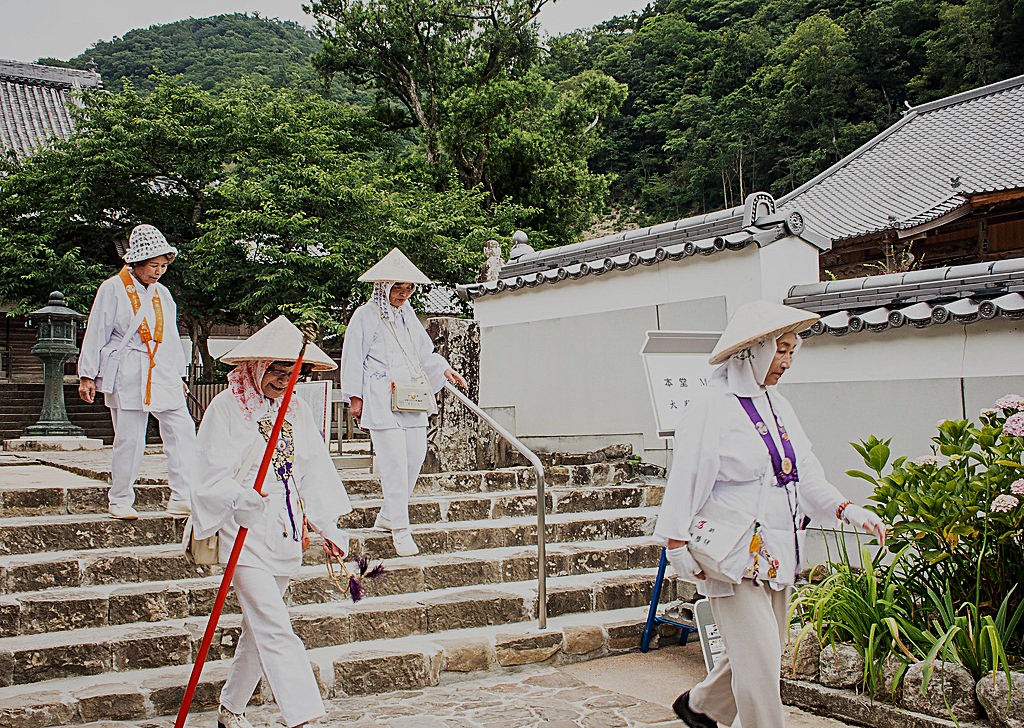
The pilgrim's "uniform" consists of white robes (hakue), which represent mental purity; a straw cap (sugegasa); and a colorful staff (kongozue). However, many tourists wear casual clothing. The Henro also provides a window into the spirit of osettai, or supporting and assisting one another, as pilgrims are welcomed and treated with care by the locals.
It takes roughly six weeks to walk the full Henro. Many pilgrims do the route in parts using cars, bikes, or public transportation (some even use helicopters). Unlike popular temples in major cities, those on the Henro are seldom crowded and are in diverse locations.
For individuals who are interested in mindfulness in Buddhist culture, Yakuoji (temple #23) in Tokushima prefecture is a great option. Yakushi Nyorai (the Medicine Buddha), who cures illness and banishes bad luck, is revered at the temple. Flights of steps leading to Yakuoji correspond to the so-called "unlucky ages" (42 for men and 33 for women). The respective ages are based on the traditional Japanese method of calculating age, whereby a baby is considered one year old at birth, and everyone becomes a year older on the first of January. When you visit Yakuoji, you can experience things like calligraphy (copying sutras) and Ajikan meditation (a Shingon Buddhist practice), so no matter your age, you're in luck. Reservations should be made in advance.
Tokushima Prefecture's Naruto City
Naruto, which is a part of Tokushima Prefecture, is renowned for its whirlpools. These are located beneath the Onaruto Bridge, which spans the Strait of Naruto and connects Tokushima with Awaji Island.
Large amounts of water moving between the Seto Inland Sea and the Pacific Ocean between high and low tide, plus with the distinctive underwater geography of the small strait, combine to generate the Naruto whirlpools.
The whirlpools can usually be seen once in the morning and once in the afternoon for an hour or two, and they happen approximately every six hours based on the tides. The magnitude of the whirlpools varies according to the height of the tides. They are usually larger in the summer than in the winter. The maximum whirlpools occur during the spring when the sun, earth, and moon are aligned. Whirlpools as wide as 20 meters can be seen during peak moments.
Boats are not endangered by the whirlpools. And the best way to observe them is from a sightseeing cruise that passes directly next to them. Cruises are offered by two companies (one in Tokushima Prefecture and the other on Awaji Island on the other side of the Naruto Straight). The Wonder Naruto tour boat cruises provide the best views of the whirlpools from its upper first-class deck for an additional cost, since the whirlpools are best viewed from a higher vantage point.
Uzu no Michi, an enclosed walkway that runs beneath the Onaruto Bridge also provides good views of the whirlpools. The observation chamber on the walkway is 45 meters above the whirlpools, which are visible through floor-mounted glass windows.
- Indexed full list of all my blog posts | articles.
- Indexed full list of all my Japanese culture essays.
Content by Your Japan Private Tours' (established in 1990) founder Japan travel expert Ian Martin Ropke. I have been planning, designing, and making custom Japan private tours on all five Japanese islands since the early 1990s. Your Japan Private Tours specializes in bespoke travel for private clients (I do not work with agents) including exclusive excursions, personalized experiences, and unique adventures. I am 100% client-centric and total individual attention. Consider my Japan travel services for your next trip. And thank you for reading my content. Learn more!