Japan private tours in south-east Hokkaido: birding & nature immersion
Wildlife is most often elusive, no matter where you seek it. But in Hokkaido there is a glorious exception, two actually, as the island is a major stopover and breeding ground for numerous migratory bird species (in spring and autumn). Many birds, including Steller's sea eagles, white-tailed eagles, and various waterfowl, pass through or live part of the year in Hokkaido as they move between their Siberian (Russia) breeding grounds and their winter habits way down south.
In the spring, key parts of Hokkaido are swarming with waterfowl and watching them up close is a naturalist's dream (yes, I love brids and was raised by a birth watcher father from a very young age!). The water bird menu in spring in Hokkaido includes geese and swans, all kinds of shorebirds and birds of prey (Ospreys, Merlins). And then we come to the smaller but equally colorful birds that range from Japanese Bush Warblers and Grey Wagtails to Asian House Martins.
As you would expect, autumn birds migrations on Hokkaido are not so different from the spring migration but there are exceptions. For example, the majestic Steller's Sea Eagles raptors begin to appear in large numbers around November and can often be seen perching near rivers where they feed on remains from the salmon runs.
Hokkaido's best areas for watching these magnificent bird migrations are Shiretoko National Park (fall), Miyajima-numa (a shallow freshwater oxbow lake, 45 kilometers northeast of Sapporo), Onuma Quasi-National Park (north of Hakodate; covered in my previous blog post) and Teuri Island (off the northwestern coast of the island; boat access only; especially in May).
For easy bird watching, unless you really like to go to the edge, consider Miyajima-numa, the Lake Utonai-ko Sanctuary, and the Akan International Crane Center (Lake Akan, covered below). Learn more!
The rest of this post covers:
- Tomamu skiing & hiking + Obihiro pork perfections
- The vast bird & mammal wetlands Kuroshiro
- Nemuro's wild coastlines & natural worlds
Japan private travel content by Your Japan Private Tours' (established in 1990) founder Japan travel expert Ian Martin Ropke. I have been planning, designing, and making custom Japan private tours on all five Japanese islands since the early 1990s. Your Japan Private Tours specializes in bespoke travel for private clients (I do not work with agents) including exclusive excursions, personalized experiences, and unique adventures. I am 100% client-centric and total individual attention. Consider my Japan travel services for your next trip. And thank you for reading my content. Learn more!
Tomamu skiing & hiking + Obihiro pork perfections
If you were heading east of Norboribetsu (SW Hokkaido) towards the bird-migration filled Kushiro marshes and Nemuro on the windy, icy east coast of Hokkaido, you will pass through the Tomamu skiing & hiking paradise. You will also have a stopover (waiting to change trains to Kushiro) in Obihiro, famous for its butadon barbecued pork rice bowl cuisine! Yummy! Learn more!
Tomamu, a contemporary high-end ski resort in central Hokkaido, is only 90 minutes from Sapporo by train. The resort's footprint covers two mountains and between them a large range of ski (and hiking in off season) trails to choose from. If you are not a skier no worries. You can also snowmobile, snow raft, snowshoe, skate and curl at Tomamu. And if you just want to soak up the heat the resort has a large indoor wave pool, numerous hot spring facilities, esthetic & spa services, and some excellent restaurants. Tomamu is also renowned for its Ice Village light up (early December to mid March), featuring amazing ice domes that are home to a bar, shops, a wedding chapel, a ramen joint and more.
A little east of Tomamu on the main train line to Kushiro (and Nemuro) lies the key transfer station of Obihiro. Obihiro is a place you must pass through but it's also the perfect place for lunch or dinner enroute to your final destination because you usually have to change trains there. Obihiro's gourmet-level butadon barbecued pork rice bowls are apparently something to die for! [I am a pescatarian and only feed pork to my dog when she's lucky or I'm extra generous. I believe dog's love pork over all other meats! Or?] Obihiro's Butahage butadon restaurant is close to the train station (in a covered mall attached to the station) and always busy hungry patrons eating butadon, year-round. But there are quite a few other butadon restaurants if you take the time and stroll a bit. Enjoy the break and the butadon in Obihiro before moving on.
The vast bird & mammal wetlands Kuroshiro
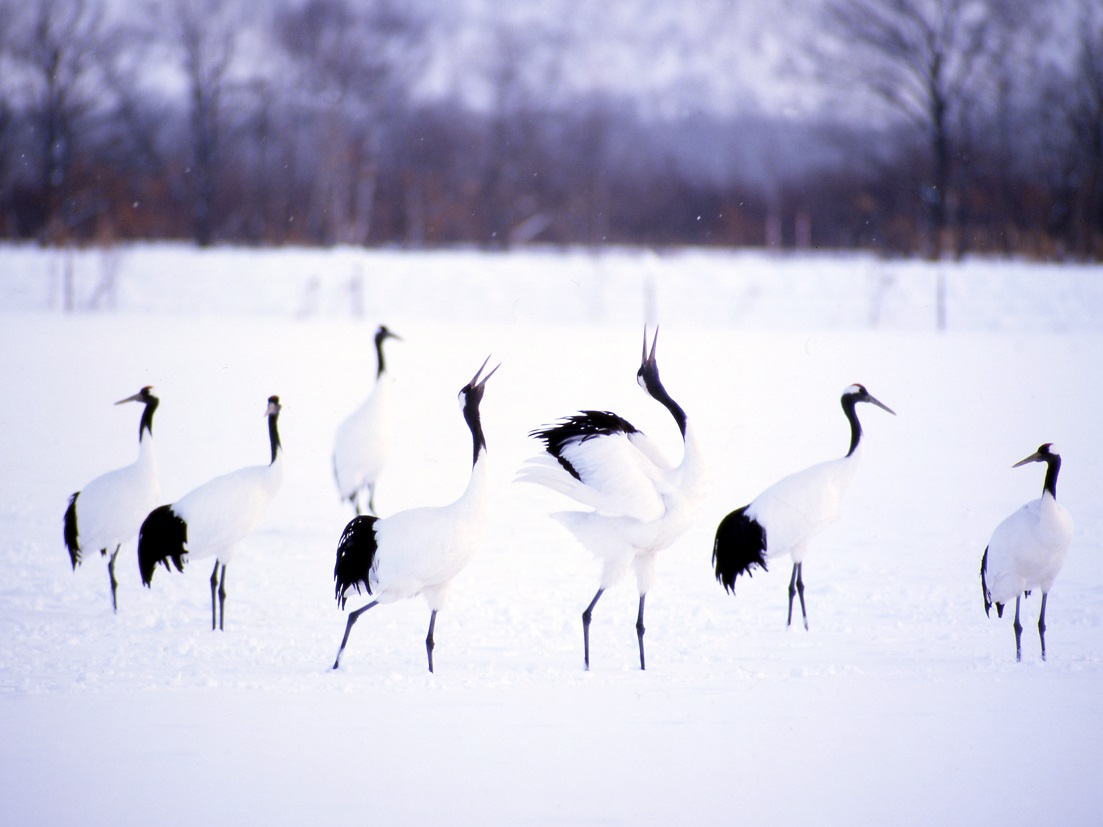
Kushiro Port lies at the eastern end of Hokkaido and home to the largest marshland in all of Japan. The Kushiro Shitsugen is a national park, and this vast marshland (which always reminds me of the heath, wet and dry, in the Sherlock Holmes' tale, the Hound of Baskerville's). The marshes are home to myriad creatures but famous for the birds that migrate through the area in spring and autumn. The gathering, feeding, mating and courting dances of Japan's stunning red-crown cranes (tancho), known the world over, can be observed in the Kushiro marshlands in winter and spring.
It should also be mentioned (for foodies) that Kushiro Port takes in a delicious range of seafood year-round. So, the restaurants near the port are selling some of the best seafood cuisine you can find in the middle of nowhere.
Last, but not least, Lake Akan, one of the biggest lakes on Hokkaido Island, which is also famous for birding and wildlife, lies 50 km north of Kushiro Port, and you can travel there through the marshes on quasi-historical trains.
Top attractions around Kushiro:
The wilderness of the Kushiro Marshlands: The Kushiro Marshland, a national park since 1987, has long protected Japan's largest wetland and marsh habitat and sole home to the only known population of endangered Japanese Cranes in in the country. The Kushiro marshes do not get massive amounts of snow in winter, mainly because they are near sea level and super wet and thus quite warm. As a result, Japan's rare tancho cranes can be photographed up close and personal year-round! These big and majestic red-headed cranes were considered extinct until the discovery of 20 birds in a dark corner of the Kushiro Marshlands in 1926. How lucky we are! Today, the colony has grown to 1,000 individuals! The cranes are at their most lively and aroused state during their spectacular mating dances. And only in winter will you see such large concentrations of cranes in the area. During the rest of the year, they spread out considerably but can still be found and photographed. And the Kushiro Marshlands offer outdoor lovers unique ways to transverse the park, including on foot or by canoe or kayak (partially on the Kushiro River that cuts through the marshland). And with the low amounts of snow on the ground in the park you can walk there or kayak there in any season!
These are the main nature observation centers in the park:
Akan International Crane Center: The Akan International Crane Center was set up as a breeding center and sanctuary for Japan tancho red-headed cranes, which can be see here year-round. The museum materials and signage are all in English!
Tancho Observation Center: The Tancho Observation Center is a winter feeding ground for the tancho red-headed Japanese cranes and is connected with the Akan International Crane Center. You will find a restaurant here and toilet facilities and a fair bit of information too!
Kushiro City Marsh Observatory: The Kushiro City Marsh Observatory connects with the Kushiro Shitsugen Viewpoint via more than one raised and slip-safe wooden boardwalk (easy walking all the way!). The observatory also has exhibits about the surrounding marshlands (again in English).
Otowa Bridge: In winter cranes roost overnight near this bridge due to the relative safety and warmth that the river provides. Bird watchers come here on winter mornings, early, to catch these beautiful birds before they head out for day to feed. You can only get to the bridge by car.
Lake Akan, a crater lake of giant algae balls: Lake Akan, a crater lake, is a huge part of the Akan Mashu National Park. It caught on quickly on Instagram because of the lake's unusual marimo algae balls. Some of these marimo can live for hundreds of years and reach the size of a soccer ball! There is only one settlement on the lake: the hot spring resort of Akankohan. From the town's eastern egde, walking trails lead through the forest and along the lake to living mud pools known as bokke. In addition to it's ryokan inns and small hotels, the town is also home to Ainu Kotan, a small Ainu village. The village is basically a singe street lined with craft & souvenir shops specializing in Ainu work. The village also showcases Ainu arts and traditions as cultural experiences. The partially volcanic area in Akan Mashu National Park is full of nature options from long hikes (and camping) to lake cruises centered around Oakan (Male Mountain) and Meakan (Female Mountain). Meakan is still active and offers some of the finest volcanic landscapes in Japan from numerious hiking trails.
Nemuro's wild coastlines & natural worlds
Off-the-beaten track Nemuro, at the far SE edge of Hokkaido, is only 2.5 hours by train west, along the coast, from Kuroshiro Station (see above). Nemuro is unique as a main destination for authentic and diverse wildlife and birdlife tourism. Nemuro is home to a network of unique ecosystems ranging from rough coastal beaches to wetlands and rocky terrains with few large trees. This is also a place where you can see Japan's majestic red-crowned cranes (see above). Nemuro is fully set up for great nature and animal watching tours: for birding, and seeing Ezo deer, Ezo red foxes, and more. Depending on the weather and how well you have prepared (preparation is everything for confident private travel, private or not!), Nemuro also stands out as special place to canoe, boat cruises, fishing tours and nature walking.
Being a port town, like Kuroshiro, Nemuro offers some really outstanding seafood options. The leading one, in season of course, are the rich dishes made with Hanasaki crab. Another local favorite, with deep Western roots, is known as esukaroppu, a crisp pork cutlet served with demi-glace sauce and buttered rice.
Nemuro is also the jumping off point to these key nature entry points:
Shunkunitai Wild Bird Sanctuary: A safe world for over 370 avian species, including the majestic Steller's Sea Eagle, Japan's iconic tancho red-crowned cranes, and White-tailed Eagles. The sanctuary sits near the end of a narrow windswept ocean peninsula less than 40 minutes by hired taxi from Nemuro Station.
Lake Furen: This lake,on the west side of the narrow peninsula described above, has a tiny connection to the open sea on it's east side. The lake is top rated Ramsar Convention-listed wetland ideal for birding throughout the year.
Notsuke Peninsula: This peninsula is the largest sandbank in all of Japan! And sandbanks are well known for their diverse flora and fauna. These sandbanks are really a huge super thin thread of virgin and windswept land like a Zen calligraphy brush stroke arcing south and then curving inwards towards the mainland. The Notsuke Peninsula lies halfway up the coast between Nemuro and Shiroteko National Park (see next post) and can only be reached by bus, taxi or hired sedan + driver. I have been hiring private vans and sedans with drivers all over the country for my Japan private tour clients. A vehicle for an hour is nearly always USD 60/hour, which is super reasonable given all the places you can visit in relaxed comfort!
- Indexed full list of all my blog posts | articles.
- Indexed full list of all my Japanese culture essays.
Japan private travel content by Your Japan Private Tours' (established in 1990) founder Japan travel expert Ian Martin Ropke. I have been planning, designing, and making custom Japan private tours on all five Japanese islands since the early 1990s. Your Japan Private Tours specializes in bespoke travel for private clients (I do not work with agents) including exclusive excursions, personalized experiences, and unique adventures. I am 100% client-centric and total individual attention. Consider my Japan travel services for your next trip. And thank you for reading my content. Learn more!